Waiting with A Listening Heart and A Seeking Eye
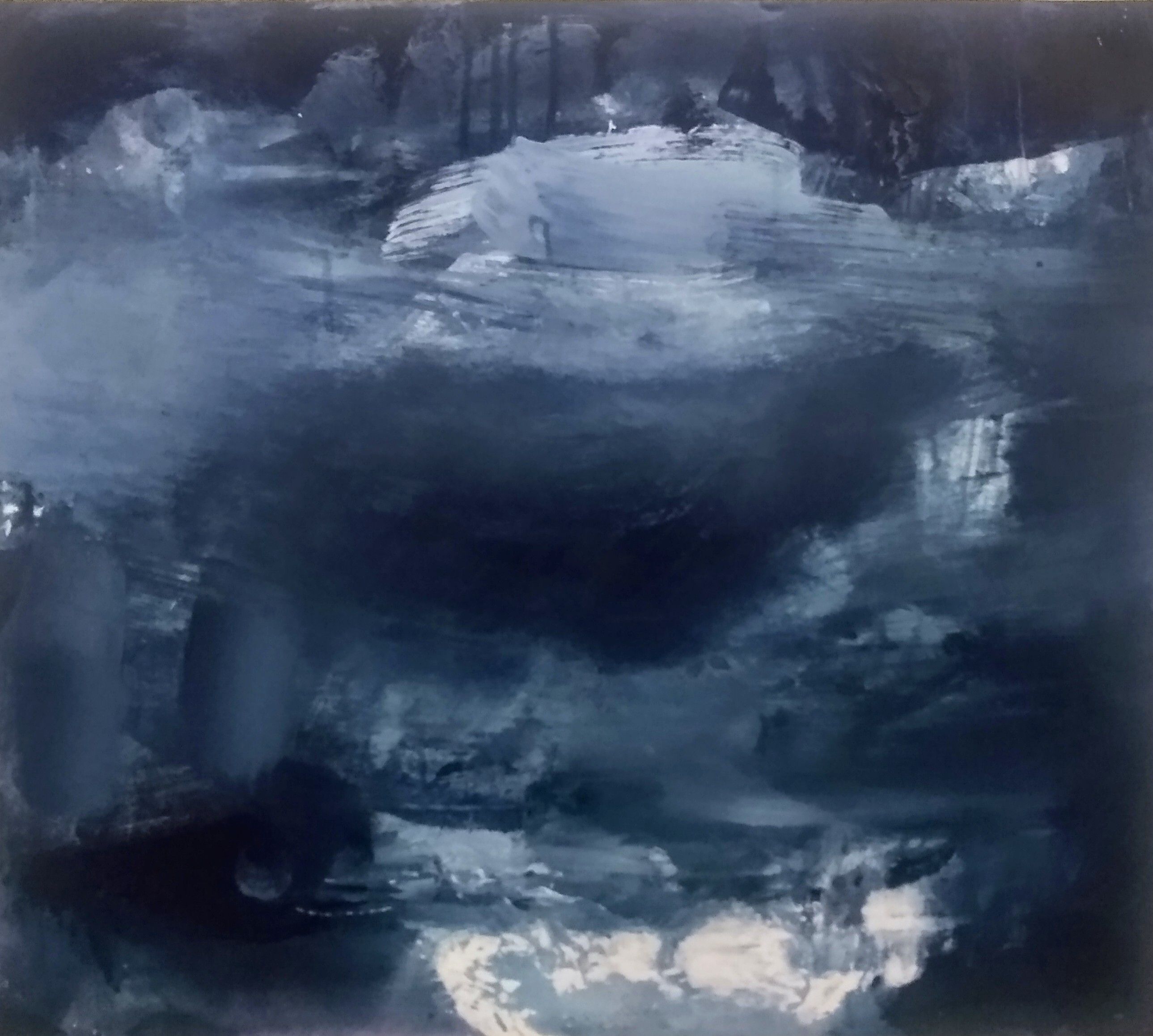
Life’s splendor forever lies in wait about each one of us in all its fullness, but veiled from view, deep down, invisible, far off. It is there, though, not hostile, not reluctant, not deaf. If you summon it by the right word, by its right name, it will come. - Franz Kafka.
In surrendering our position at the center of the universe we delay our limited self-action for another kind of holding-back. Selfless in front of the painting, we stand by, extending our view to the essential image of creation itself rather than by any projected image of the finished product. When the waiting is over, the time and space right, we pick up the brush, begin again, unrestrained and free. The studio that was a waiting room is now the given moment for the opening, forming, and transforming of infinite possibilities beyond all need and aim.
Waiting is our longing for a different painting. If the painting is deemed worthy of the waiting, we establish a relationship with its waiting-time, for its midday stars to brightly guide us. Nonetheless, it is a lingering sense of potential mixed with impatience and dread because to detain time is to work between shadow and space, burning with the prophetic against the flush of an evening sky. To pick up the thread that binds memory to the heart in this shadowy air, we dream our way along until something rings out like a spur ricocheting far off. The Argentine fabulist Jorge Luis Borges wrote “Time is a river which sweeps me along, but I am the river; it is a tiger which destroys me, but I am the tiger; it is a fire which consumes me, but I am the fire”. In Time we wait for profound and nascent dimensions.
Most often, we stand in front of the painting without acting. We anticipate and agonize. We reflect helplessness or the inability to control the pace, course, or outcome of our creative work. We forget that waiting is a virtue. We fail to remember and understand the pros and cons of opportunity before seizing it. Instead, we wait like the women at the window in Matisse’s painting “Waiting:” active yet anxious, between hope and resignation, fulfilment and futility. Waiting that extends across barren mental and emotional planes.
Are we procrastinating or truly waiting? Are we putting off our work intentionally and habitually? Dawdling, lagging, and loitering, moving slowly through our laziness and apathy? Can we tolerate more delays? Do we have the ability to “creatively” wait, or to continue doing something despite difficulties? To wait for something, that is, to anticipate something that will physically arrive or happen? Or to wait on something, to attend to the painting, spontaneously acting before any “rational” decision? Under the mat of our passions take the magic step in the distancing itself. And for the renewal of expression to announce itself.
Waiting allows the painting to be seen in the way it sees itself. Seeing that is a letting-be in order to gather around the kernel of a dream that calls us to discern. In-different, not stuck in a time-cancer like a character in a Beckett play but a positive, actionless activity (in the Daoist sense) that is a way to decenter the ego, to empty the mind and promote a state of awareness beyond artistic identity. A verb swaddled as a noun that is an internal pause without signification, desultory movement, or never- ending spiral of purposelessness. A waiting void of meaning and the incessant search for presence, but a clear space for re-fertilization. A departure in whose latitude weighs anchor in the gossamer of a new desire. Not the song the day before but the song of songs that is a rent in linear time. The margin between the present and future. An eternal Now that is a metaphysical monism, where rational and irrational marry to form something new. Moreover, revealing a narrative thread to pursue, what Nabokov called in Speak Memory (1999) that “blissful anastomosis provided jointly by art and fate.”
We can wait poetically for change to deeply touch us, to conceive our work as a longing for something that rings and bays. In our unrest, as well, there can be a pause that is a play-like truancy touched by the curious wire we carry within. At the center of our waiting, we become attentive, opening ourselves to the comings and goings of our mind. Learning all the while how things pass in a blind rush and by what hidden channels we come to speak of those secret images important only to our deepest selves. Waiting loosens selfness like a bad tooth.
What we do in the studio is entwined with universal principles. They are not separate things but one whole, nondual action. It is about trust and the transience of moments. Something happens, ends, or begins. Or nothing but the waiting itself, in itself, and for itself. To be fully present, not simply to be “aware,” but an attending as an act of generosity to oneself, a way to inspire critical thought and the sense of what is waiting.
Waiting is weighty. Waiting has gravitas that should be noticed and valued. It is not an inconvenience. Waiting is an advent, a looking forward, a forward look to return to the coal of life. A Vergegenwartigung (German) “bringing into the present”. But it can also translate as “visualization” or “realization”, a “presencing” (more than a presentation). A waiting that equates, from the time of Plato, be-ing with presence. According to Holderlin (d.1843), German philosopher and poet, every process of coming into presence is at once in itself a process of being absent (open to possibility). An appropriation that allows what-is to come into existence. Poet Charles Bukowski (d.1994), in a letter to a friend, wrote: “Somebody asked me: What do you do? How do you write, create? You don’t, I told them. You don’t try. That’s very important: Not to try, either for Cadillacs, creation or immortality. You wait, and if nothing happens, you wait some more.”
You may not exactly know what the waiting is for. But focus on what appears, however hazily. If it is not immediately placed in context, it breaks away. It demands spontaneity. A recalibration is what we seek. Neither a backward or forward slash, but that certain unexplained waking up given to the power of the imagination that incubates and prototypes with an eye toward aesthetic expanse and mercurial speculation. In short, waiting is the largesse of contemplation. To see what possibilities lie beyond the edge of conventional understanding, what T.S. Eliot deemed, “the still point of the turning world”. And because every work of art is a mirror of life, our paintings are always waiting to be returned to us.
Waiting is not not-knowing but an un-knowing that opens us up with a listening heart and seeking an eye to the holy hour of our vision. The vastness of potential in which it beats a vibration like a rainbow of light. In the recesses of time and in the passageways of spirit, we wait. Within the nihil of our lavender barrens, we wait. Against the angles of enigma, armed with absence, we wait for the rise of our unsung song. To paint in the way one breathes, moored to the blood, but as a flame braided to the individuality of our essence.
Playing out an infancy of the senses and of sense, Walt Whitman in Song of Myself sings:
One world is aware and by far the largest to me, and that
is myself,
And whether I come to my own to-day or in ten thousand
or ten million years,
I can cheerfully take it now, or with equal cheerfulness
I can wait.
Waiting is the thirsty secret, and the slaking mystery.
Comments