The Transcendental Tangle
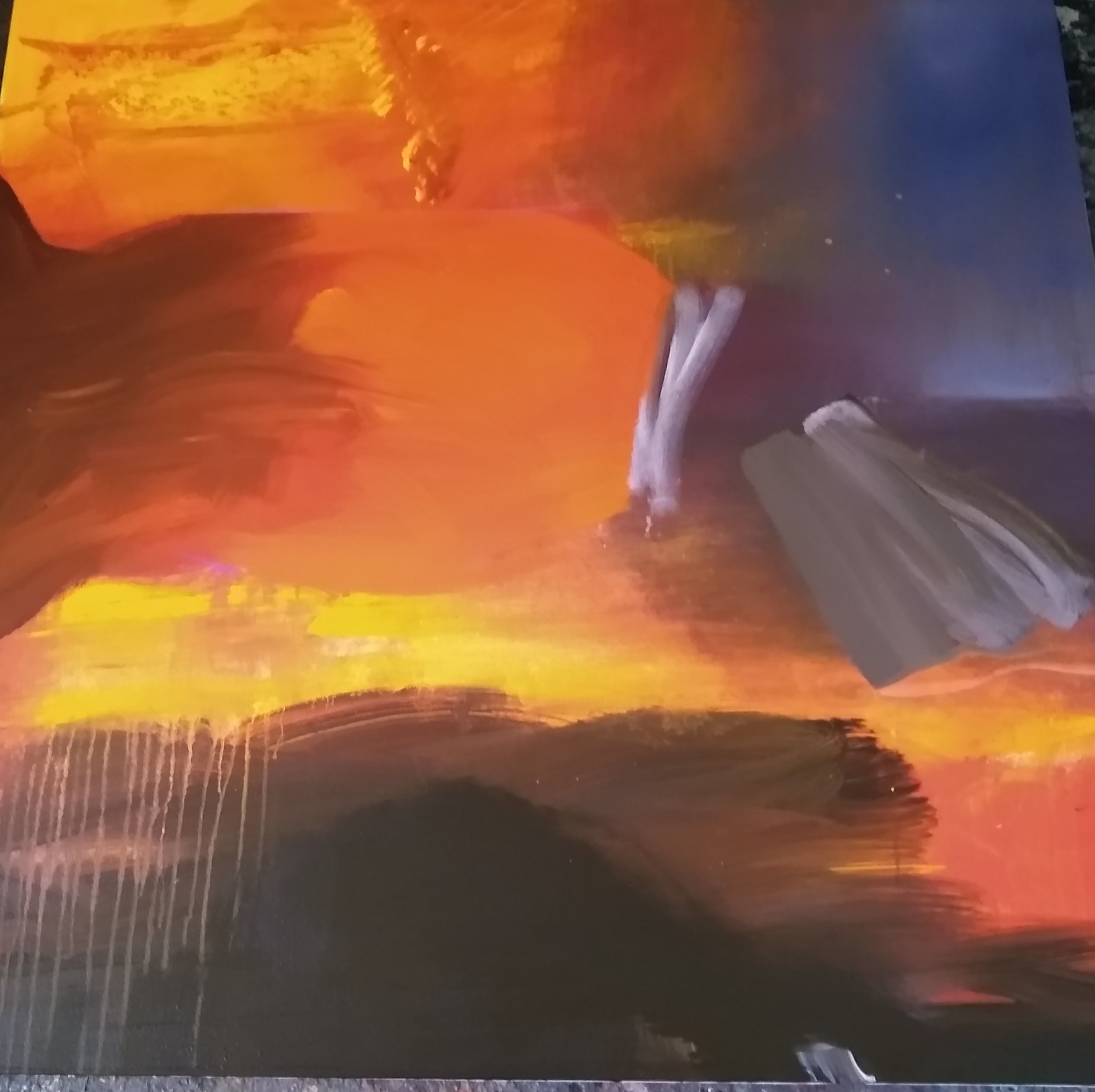
The Transcendental Tangle
“I am large, I contain multitudes” bard Whitman (1819-1892) announces to the world in Song of Myself. Whitman saw himself not just as an individual, a single human being but as a vessel for all of humanity, nature, and the universe. “To me the converging objects of the universe perpetually flow.” His expanded sense encompassed everything, celebrating himself and the universe as one.
We need an alternate, Whitmanesque, vision. Not a “post-post modernist” (a dubious kind of “meta” criticism) take on painting but one that reveals the central pattern redefining the primary analogue. Paintings that newly-present a certain contracted trajectory occupying the line of sight beyond conventional time and space. We can agree with Sri Chinmoy Ghose (1931-2007) who said “There is only one dream that will always be perfect in our lifetime. And that is the dream of self-transcendence”.
The universe of unfolding creativeness is forged within our story and the world, but also beyond the world. Knowing this entails a transformation of consciousness, a reconfiguring of understanding of what we see and know. Learning this is not the same as learning to analyze or predetermine the work. It is a journey to take with the work rather than a technique or style to fall back upon. A transcendental vision that re-stores the storehouse of the imagination because it is the bridge between revelation and lived experience. A cultivated seeing with attentiveness, patience, and receptiveness. Where the image appears not as an obstacle to meaning but as a carrier. As such it will not lose its transcendence. It remains unlocked without being empty or relic of the past. “I know well enough the perpetual ‘myself’ in my poems” Whitman tells us. “I am all, I have all lives, all effects, all hidden invisibly in myself”.
When we grab something, we literally reach beyond ourselves. Our aim moves away from us towards something. We usually relate things by reference not identical to them. Aiming toward and beyond is a form of transcending. Transcendence is something naturally we do. We are always transcending things, including ourselves.
We transcend by projecting possibilities to make things conceivable for a deeper understanding. A temporality at once ecstatic (literally “to stand outside oneself”) and vertical, projecting for its own sake the horizon of its future. In order to act upon the transcendental imagination with futurizing intention we respond in a certain manner. However, this requires authentic and vulnerable participation. Closely held something different emerges: a new understanding, a new attitude, symbol or metaphor.
Moving between philosophy, metaphysics, cosmology, and theology intentions become shaped by time, mortality, memory, and love. Meanings are discovered, constructed, and chosen. Necessity, contingency, worlds become open to these evaporations. We still speak of painting, properties, and parts. We still recognize they come from a deeper place of consciousness, a centered place of subsistent mystery giving form to earth and sky and fleeting days. What is redemptive and salvific in the face of raging nature.
The malaise of our contemporary lives (and by extension our work) has “left us adrift in a universe devoid of transcendence and existential fatigue”. Haunted by anxiety, fragmentation, and loss of meaning, a condition contemporary Canadian philosopher Charles Taylor calls “the dark side of self-suffering”. Without orientation we are aesthetically exhausted. A flattening of human experience where depth and purpose is replaced by utility, aspiration, and consumption. The imagination has lost its vertical axis, oscillating between ennui and distraction.
Transcendence, broadly speaking, is the rising out of or above other things, the property of being, in some way, of a higher order. Being outside or beyond the world. Beyond the limits of what we normally experience, and whereas anything belonging and drawing consequence from the power of potential and the limits of experience. The word signifies surpassing, exceeding, surmounting, supreme, pre-eminent, peerless, ideal, abstract, infinite, boundless, sublime. All things regardless of their ontological kind or category, superordinate to classification.
We have only to recall the philosophical or religious movement in mid-19th century New England called Transcendentalism. Characterized by a belief in a transcendent principle in human nature, Emerson, Thoreau, and Theodore Parker being the most important. Of course, there are the Kantian transcendentals: perfect truth, perfect love, perfect justice/goodness, perfect beauty, and perfect being.
“Transcendental” arrives from the Greek hyperousia “beyond being.” The equivalent in Latin “transcendental”, transcendentalis, which translates “to climb over”, “rise above”, “step beyond”. Although the Greek term begins with Parmenides (late 6th or early 5th BC), it is Plato who explores its dialectical feasibility in his Parmenides and Republic. It comes to the foreground in the revival of Pythagoreanism and Platonism coupled with the introduction of the Semitic tradition of transcendence (see Philo) and later in the Platonism of Albinus (fl. c.150CE).
The greatest transcendence – the transcendence of transcendence – is ultimately immanence, or that which is “contained within.” An energy- force that is a natural or permanent part of an object, mind, or system. It is this indwelling presence that allows us to see beyond ourselves to reach beyond ordinary limits, everyday experiences, and the physical world of habitual tendencies. Both a mutual identity and mutual penetration, one that is meaningless without the other.
Freedom results in an intuitive knowledge that is self-oriented and self-sufficient. The painting process embodies both transcendence and immanence not yet conscious of what has gone before or is coming after. A “cosmocentric” dimension that breaks the shell of forgetfulness. A gnosis of inwardness and interiorization, the plane of transpersonal awareness that allows a special temperament of spirit to soar beyond the summit of facts and data. The indirect and passive participation in the mystery of the universe as a theater of images.
From paleolithic painters to Chinese Daoist “dark-enigma” shan-shui (landscape) painters, from painters of Spanish retablos, Russian icons (archeiropoieta,“not made by hand”), and Tibetan thangkas (tankas), from Kandinsky to Kiefer, artists have sought and claimed other dimensions to their works. Transcendental art (with intention) and art that is transcendental (without intention) that carries painting within the physical world and beyond into spiritual, cosmic, or imaginal realms.
The short-lived Transcendental Painting Group of New Mexico founded in June 1938 by Raymond Jonson and Emil Bisttran and disbanded in1942 due to World War II pioneered explorations of pure abstraction and luminous color. They laid the groundwork for later Color Field painters like Rothko and Newman and the Light and Space movement of the 1960s and 70s. Formed in Santa Fe and Taos their work embodied radiant geometry, pulsating colors, and ethereal light to evoke higher consciousness. The collective of visionary artists stating in a manifesto the goal was to carry painting “beyond the appearance of the physical world, through new concepts of space, color, light and design upon planes that are termed idealistic and spiritual.” Pure abstraction using colors, forms, geometric structures to create “absolute paintings”.
Heavily influenced by theosophy, Eastern religions, and metaphysical writings of Wassily Kandinsky (1866-1944) and Nicolas Roerich (1874-1947) they sought to visualize the rhythms of music, breath, and the vast desert skies, turning their canvases into vehicles for meditation. Other artists in the group were Robert Gribbroek (d.1971), Lawren Harris (d.1970), William Lumpkins (d.2000), Florence Miller (d.2007), Horace Towner Pierce (d. 1958), and Stuart Walker (d. 1940). Alfred Morang (d.1958) and Dane Rudhyar (d.1985) were important non-artist members who contributed intellectual theory and criticism to the group. In 1940 they exhibited at the Museum of Non-Objective Painting, now known as the Solomon R. Guggenheim Museum and Foundation and at the Museum of Modern Art. (A new generation of transcendental painters continue the tradition of esoteric abstractionists of the 1930s using cosmic geometries, chromatic figuration and fields, atmosphere and non-objective symbols.)
Out of the luminous night of the infinite comes the dramatic titanism of Jackson Pollack (1912-1956), a central figure in the abstract expressionist movement. He saw what others could not. Pollack’s paintings, it can be said, have the imprint of inwardness and essentiality, the action of movement for the viability of the “transitional surface” (“action” and “transition” words borrowed from Emerson). His paintings reflect not only a state of being, visceral and spontaneous contact, but a liberating artistic gesture impulsively arising from the unconscious. This is not automatism or simply self-expression but the artist as agent of creative insight. “When I am in my painting, I’m not aware of what I’m doing. It is only after a sort of ‘get acquainted’ period that I see what I have been about”. In his natural habitat sensual ecstasy, behavioral anxiety, and sweet redemption were the engines of his practice.
There is a sense of vast, unending spaces of imaginative boundlessness in Pollack’s paintings. Paint sails off the edge of the cosmos in urgent joy with kinesthetic force. Paintings become cosmic maps, topography and settlement, a sense of limitless flight. The pictorial equivalent to the infinite that spreads through Walt Whitman’s Leaves of Grass. They are the archetypes of the transcendental tangle, rethought how the cosmos and unconscious mind were depicted, shifting from literal representation to physical energy. Abstractions of space and reality that mirror the swirling, immeasurable nature of galaxies.
As with transcendence and immanence, macrocosm and microcosm ride tandem. Outer realms of Pollack’s cosmos with their star-like clusters and array of galactic filaments vie with interpretations of intricate, repeating fractal patterns and vibrating quantum actions. Poured paint mirroring the deep geometry of nature like branching trees, landscapes, coastlines, the inner realms of the human body, major veins, and neural network. Organic systems with complex voids and rhythms. Nowhere is there the traditional focal point and horizon line. All this allows the eye to wander continuously, simulating the experience of looking into infinite space or deep into the body electric.
Instead of blending color in a traditional manner, Pollack allowed the raw canvas to absorb the pigments that separate line from color. Fluid effects of interlaced webs of paint, skeins of spontaneous, swift drippings bypass the rational mind. This is the internal, primordial world of the unconscious as exceeds the summit of rational knowledge. The psychic function that arises from the tension between consciousness and the unconscious that supports their union. The outer limits seen from the deeply enclosed and intimate.
Physics and Jungian symbolism are married into a cohesive, abstract sweep. Suspension of will, and spontaneity, give the unconscious form and meaning, bringing together opposites for the production of a third: the transcendental. A middle ground (not unlike the imaginal) on which opposites are united. Jung: “If for instance, we conceive the opposition to be sensuality versus spirituality, then the mediating content born out of the unconscious provides a welcome means of expression for the spiritual thesis, because of its rich spiritual association, and also for the sensual antithesis, because of its sensuous imagery. The ego, however, torn between thesis and antithesis finds in the middle ground its own counterpart, its sole and unique means of expression, and it eagerly seizes on this in order to be delivered from its division”’ (Collected Works, par.827)
It manifests symbolically and is experienced as a new attitude toward oneself and life. “In this way” Jung continues, “ it becomes a new content that governs the whole attitude, putting an end to the division and forcing the energy of the opposite into a corner channel. The standstill is overcome and life can flow on with renewed power towards new goals.” (CW)
Every unresolved painting is an abortive metaphysical experience. By denying the transcendental value of one’s paintings or the reality of their reach, we amputate the very faculties through which meaning becomes accessible. Transcendence shows itself by interrupting who you are for the prophetic and inspired, the “more” that is self-enclosed as the site beyond. Interpretation being the opening and obligation, the description of inspiration and revelation. It exists in the one who sees it. Enigma and ambiguity become pretexts for new profundities.
Transcendence is a vehicle of becoming, a paradigmatic model despite its “otherness”. It is through the process of painting, the world alterity and psyche, passing from the finite to the infinite that brings about a new understanding in the form of scattered sparks and oblique traces of our own infinitude. The night of the world where transcendence awakens the unpretending nobility of the soul.
We need to establish painting with its own register of meaning. Be compatible with multiplicity instead of consuming the already existent. Make it so much more thinkable and engage it all the more deeply. Painting is a language at its most semiotic and somatic that articulates an ontological primacy prior to any meaning and sense. An appreciation of painting’s philosophical or spiritual potential that points to the way in which an idea or confluence of ideas can be brought to illuminate and access something new with significant influence that is both antecedent and “pre-original”.
We must restore dimensions of studio practice that we have been taught to ignore. We must counter fear and forgetfulness by the courage of affirmation and acceptance. To transcend all things is to accept them. We “play it out” and we find bliss in the playing because it is grounded in freedom, intuition, and imagination over reason, logic, and habit. The capability of being free from any binding orientation.
A transcendental aesthetic in which the apperception and investigation of possibility of moving beyond them. A move away from one thing and a move into something else. A transcendence that reflects our conception of studio practice, in general, and painting, specifically. It is in this sense that what we do concerns human agency.
To respond to what apprehends: a recurring way of sustaining the open space of meaning, replicated at every level of practice. A reiterative paradigm of continuous creation that is the transcendent interiority hidden within us and the process of painting. The dimension of height available to metaphysical desire. The gradient of transcendence that inflects distance into elevation. The “uprightness” towards the space of creative existence.
To avow oneself as answerable not only by understanding but by a sense of value of new signification. The continuous creation of subjectivity not as a series of disjunctive instants but the maintenance of need. To bring enough light to see the patterns, mechanics, and dynamics indigenous to grappling with process and imagery regardless of style. Uncovering something already inherent and receptively discovered.
The sense of “ripeness” communicates the construal of time as the future perfect tense, that is, the present that perpetually awaits unfolding. Concealed, revealed, transported, and captivated. A transcendentalism that places us naked and humming in the dream of the universe.
It isn’t about escaping reality. It is seeing reality with absolute clarity.
Perhaps there are too many stars in that corner. Our self-seeking text knows itself better than flesh and blood.
And sometimes a glance listens.
An unclosed domain radiating about a wholly visual center.
In a rush of rebirth making our organic pulsations felt.
Comments