The Texture Of Seeing
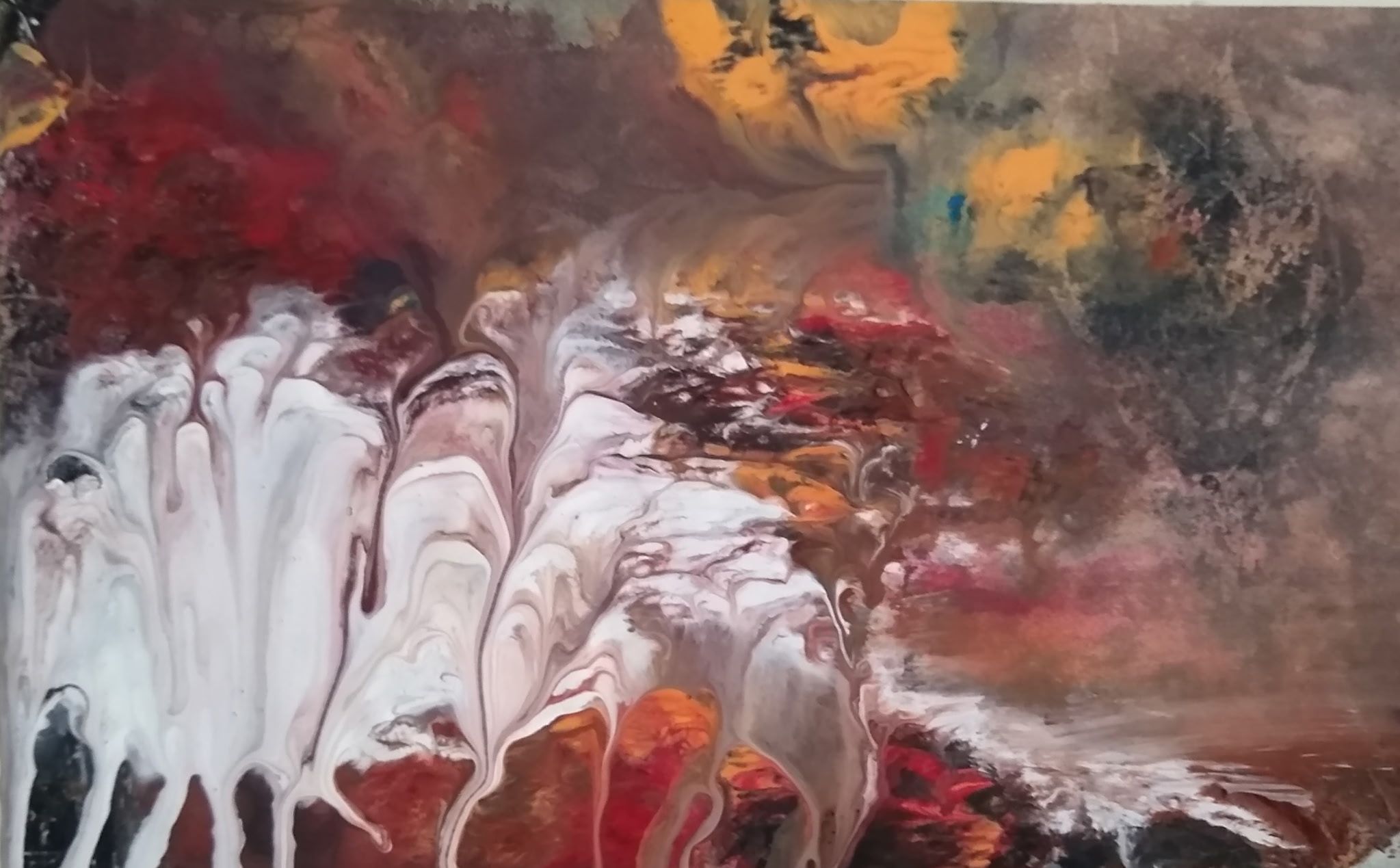
The Texture of Seeing
The texture of a Van Gogh painting is not simply the application of thickly applied paint
but the relief and visible ridges of his inner life. -Dadaamericano, c.1980
We weave with the thread we are given, when we weave. -Antonio Machado (1875-1939)
Fractures, ridges, cavities and rims. Unexpected jaggedness, or smoothness that scarcely undulates. Depressions, hollows, spikes and stones. The sleek softness of satin, the hard nails that scratch one raw. Ivy that bulges in yesterday’s sunlight. An impassive throat adorned with cold gems. The weaves of canvas, the hot and cold press of paper, the decorative openwork of lace. The wayside wild: thighs of light, tongues like amber, breasts of polished glass. All rending jolts. Hairs and veins, vitreous membranes, the realm of corporeality that has nothing to do with the evidence of reason. Capturing our eyes for the touch. Entering the depth of our grain with the great fluttering of wings: painting’s birth giving textures.
Texture is an artistic element used to depict depth and dimension. Used as a way to convey meaning or merit to a work, it helps serve the narrative to connect on a deeper, more sensory level. Texture brings weight and movement. It guides the eye toward a certain reaction. As a popular style of depicting visual texture, trompe-l’oeil (“fool the eye”) creates the illusion of materiality. Employed with intricate details and layering color, or the optically blending of contrasting or complementary colors side by side, the eye is easily “fooled”. Nuts and bolts, straw, clay, ash, shellac, steel and lead work with paint as well (see Anselm Kiefer) to create powerful visual and metaphorical surfaces. Artists use all kinds of materials and tools like palette knives, spatulas, sponges, scrapers, cloth, string, twigs to create a wide range of tactile effects. The important strategy is in layering to alter the density and richness of the surface meaning.
Texture of seeing is a visual or implied texture. An optical quality perceived by the eye rather through physical touch. Texture that relies on learned physical associations and memory that have temperature and resistance. Visual-tactile synesthesia that makes the viewer mentally or physically feel the texture in painting as in Van Gogh’s “The Starry Night” (1889) simply by looking at it. Complex repetition creating textures to seem dense, grainy, or soft that translate the tactility before we actually run our mental fingers across the surface. Implied texture, actual texture, abstract (simplified or modified) texture and invented (no real-world counterpart) texture bring the physical act of painting into real life. Textures that do not distinguish between those which we can only understand but not imagine, and that which we can also imagine. Whatever can be grafted, both precise and precarious, knowingly or not, but pleasantly assured.
Texture, intertexture, text, and weaving share a deep root in the Latin verb texere, “to weave”. Textura, “a weaving” or “web.” Textus, “a woven thing”. Its Proto-Indo-European root to weave or fabricate makes it a cognate of the Greek word techne, today meaning “art” from which is formed the word “technology”. Text (a written work), textile (a woven work), texture (the structural surface quality of a work) and intertexture (weaving different threads, elements, or parts together) all describe physical or conceptual networks built by interlacing individual words or lines into a unified whole. Lines, fibers, strokes of ink, paint, or charcoal repeat to form a particular tactile or tangible surface. Topographical layouts that rely on a modular grid of crosshatching that mimic the warp and weft threads intersecting at right angles as if on a loom.
Texture has its origins in myths of weaving: the woof (weft) of war, the warp of language, history, and the time of binding. The spinning of yarns, the weaving of narratives, the lost thread of a thought. Destiny and time, cunning and survival, voice and truth, all associated with weaving. In the long list of weavers, we have only to recall Arachne challenging the goddess Athena to a weaving contest in Ovid’s Metamorphoses [Bk.VI (6)], the Moirai (Fates) spinning, measuring, and cutting the threads of human life and destiny, the Chinese star goddess Zhinu, the youngest daughter of the Jade Emperor weaving colorful clouds of heaven. In the Hopi and Navajo traditions, the Spider Grandmother creator-spirit who shapes and weaves the universe and guides humanity, the Norse queen of gods, Frigg the wife of Odin spinning Orion’s belt, as well as Brigantia, “The Exalted One,” a weaving deity closely linked to the Irish goddess Brigid and the Gaul goddess Brigindu. Most famously, in Homer’s Odysseus, there is Penelope, faithful wife of Odysseus weaving by day, un-weaving by night. As well as Circe and Calypso, two weaving enchantresses. Then there is fair Helen of Troy at her loom in the Iliad, who burnt, in Doctor Faustus, the topless towers of Ilium.
There are biblical references to weaving in the wilderness by the Hebrews having escaped the tyranny of the Egyptians who were also highly skilled weavers. In medieval Christian times there was the image of Eve shown with distaff and spindle as well as many designated Christian patron saints of various aspects relating to textile work. Even Mother Goose, traditional teller of tales, was associated with spinning. Marriage and birth is both weaving and a binding that gives cord significance to fate. The thread is the length of life. Each warp-thread represents an individual. Hinduism speaks of a “thread-soul.” (The rite of adoption into the wife’s kin, the bridegroom’s height is measured by a thin thread.) Of the Valkyries it is said a “weft of crimson” binds doomed warriors. Associations of magic with binding appear, as with the name of the Sirens, which mean they bind or enchain with hypnotic song. The word “spindle” originally meant “lungs” attached to the diaphragm securing it to the body. In the Agamemnon of Aeschylus, the chorus chants the heart “unwinds off the spool” as with the woof-thread in weaving. (An interesting connection is found in burial artifacts between the sun’s spindles and spinning.)
Just as a weaver locks vertical warp threads with horizontal weft threads, a writer locks syntax and vocabulary to form meaning, while the painter builds up the tactile surface that visually describes the stylistic density and “grain” of the work. It is all about the surface of the canvas or paper and how it is perceived. Encoded by light and shadow spatial details are registered bridging sight and touch. Rich, detailed, or layered qualities of a visual moment or memory. For some, the texture of a painting, a particular word, or musical composition involves a neurological crossover synesthesia. This allows certain individuals to genuinely feel what they see, read, or hear. Texture too, can have a kinesthetic movement or tension. So that something appears moving , coiled, ready to spring up.
The level of interconnectedness is in the texture of seeing. The seemingly illusory as the realm of dreams and visions, representations of existence, and various kinds of visual “deceptions”. Confined by the boundaries of impermanence, contingency and mortality, there is the texture of awakening and timelessness through sensation and setting. The horizon of human perception of real or imagined touch, a holistic truth, if you will, in each particular sensation. Like flowers that do not bloom because spring is a recurring season and its time has come. But rather springtime itself manifests through the opening of the blossom. Texture of seeing is an external confirmation of the interior flowering of awareness.
Texture in painting denotes the surface quality of the work. It can be actual textures (thick ridges of paint, mixed media, heavy brushstrokes) that adds depth, creates focal points, and triggers emotional or physical responses. Texture breaks up flat spaces, mimics real-world materials. Drawing the eye to key areas by placing rough zones next to smooth areas. Aggressive marks convey energy or chaos. Smooth gradients, calm and quiet. Impasto stands out in relief, scratches (sgraffito) or scrapes through wet layers of paint reveal forgotten or hidden forms and colors. Dragging a nearly dry brush with a little paint over textured surface catches high points. Implied texture is the optical illusion of light, shadow, and line to make flat paint look like skin, rough stone, metal, glass, etc. Collage releases desire to make physical contact that alters and determines persistence and control of formal perceptions. How objects intersect our consciousness and existence that lie beneath everyday life.
Texture of seeing lies in the impulsiveness of matter and on the frontier of the lucid senses. Yet for texture in a work there is a set limit. Nonetheless its immobility translates into an infinite variety of feelings generated by the infinite diversity of their materials and forms. Textures appear as reflections of their relationship to us. Removed from their own home-ground textures are transferred into our consciousness, into our senses and intellect. They reveal their own “selfness”. A fragile egg in the palm of the hand or the velvet “feel” of cloth are about human passions as well as producing an ontological vibration that speaks to their and our existence.
We who see this do not see it from the depths of nothingness, but from the midst of itself. We yield to texture as to all things seen. The enchantment is in the untutored elements. The thickening strata and differentiation raised raw to dimension and extension that ride on vision, on the poetry of touch.
It is how we carry the world.
Comments