The Sad Still Life of Tulips
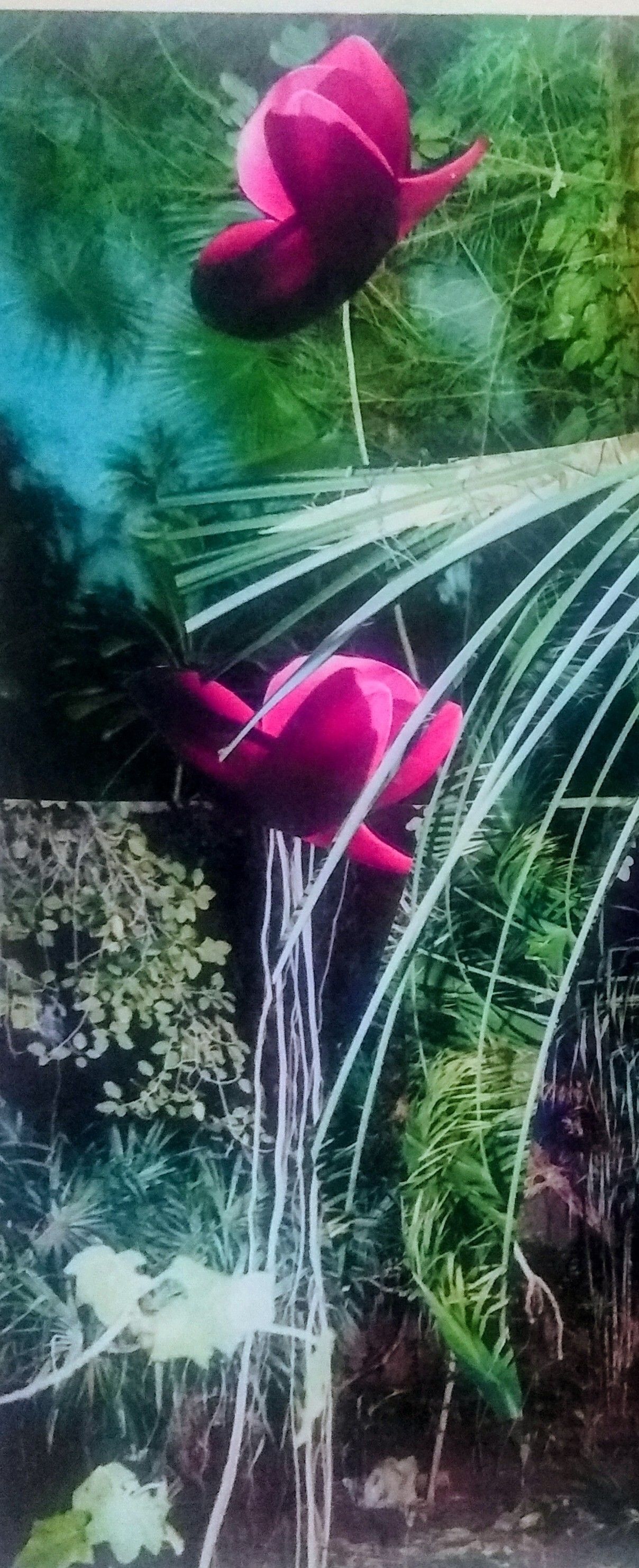
Still life painting was an established genre in Northern Renaissance and Baroque periods often valued for its detail and symbolism. Flowers painted in suffocating compositions at the peak of bloom kissed by impermanence. Flowers that gave their fragrance away in handfuls before long going under dead leaves like a calendar that has marked its days.
The fundamental practice for artists to hone their skills of rendering, placement, light and shadow. Artists that could explore color theory, techniques of brush, positive and negative space. Or focus on emotion. Still life could be a vehicle for social commentary. Captured, cut, and arranged in a complex or simple arrangement, a powerful symbol or metaphor when referring to something other than itself.
However, “still life” is stilledlife. Calcified and bloodless. Stupefied under studio lights, flowers that have the posture of sadness as if sealed with wax. Motionless with the hush of absence, they form a shadow, divide life. They can cry but never do. They simply curl without a breath of wind. In service they wait like fish locked alive beneath the ice of a mountain lake.
With more than 250,000 named species of flowering plants the world got its blossoms, its bouquets, its perennial borders. Centuries of flower paintings on walls, papers, cards and canvases. Flowers that have sexual organs. Perhaps one reason why we find them romantic. Tubes, ovaries, swelling lips, rigid stems. Seeds as embryos evolving 150 million years ago out of non-flowering plants that played a pivotal role in human evolution. Flowers, like humanity, that began as seeds, grew, blossomed and died. For this alone we should honor their impermanence.
Tulip history began in Central Asia (the Near East or Mediterranean) as wildflowers. It is believed they were first cultivated in Turkey around 1000 A.D. During the Ottoman Empire (circa 1299 to 1922) they became the symbol of status. In the late 16th century tulips were introduced to the Netherlands and subsequently brought to Europe by biologist Carolus Clusius. Most modern tulips are descendants of the Tulip suaveolens, a red flower native to Crimea which sultan Selim II loved so much he had 30,000 bulbs brought for his palace gardens. First mention of the tulip was in the late 11th or early 12th century in Omar Khayyam’s Rubaiyat, a book of poetry that explores universal themes like mortality and the fleeting nature of life.
Tulips were thought to have entered Western Europe via an Ottoman ambassador to the Habsburgs, who first recorded the word “tulip” in a 1554 manuscript. The Farsi name for “tulip”, laleh, sharing letters with the name of God (Allah). The name can also be written as lale or dulband, “turban”, that may have inspired the English word “tulip”. In the 1590s, in Holland, Charles L’Ecluse planted the flower at the University of Leiden’s gardens. From 1634-1637 “Tulip Mania” occurred in Amsterdam. By 1632 they were growing in settlers’ gardens what is now Manhattan (then New Amsterdam). By the time of the American Revolution, tulips were entrenched in American garden culture. There are 150 species of tulips, 3000 varieties. Meanings differ by their colors. For the sake of brevity, the most common themes being passionate love, rebirth, and new beginnings; happiness and caring affection; purity, forgiveness, royalty, innocence, and hope. During the Victorian era tulips were associated with charity.
Far from a relatively superficial and soulless affair, immigration from blossoming to decay is weighty with the dissolution of time. It shakes us with a shudder in echo. Reason enough to suspend our quick and habitual vision for any flower’s noon ascension. The spatialization that allows the suffocating atmosphere and preordained category of “still life” within an orbis pictus.
Nature morte epitomizes still life’s imagistic mode of representation. Still life, “dead nature”. A bouquet invisibly shrouded in deep mourning. Close to the beholder’s eye, who with bowed back, is unaware of its posthumous odor of seduction. Seeing the sad still life of tulips will not arrest the slow erosion that enters the soul. As a replacement for death, we assign it a magical thought that lends power to its budding.
It seems that between what we see and think about still life with tulips we remain enslaved to the image. It exposes both paint and language to the limits of sensation. Presence upon a background of disappearance. At the same time this truth is also a lack, a powerlessness. For what truth has jurisdiction over cannot be a totality. Truth can only be half-said. Taking the thing whole and showing it misses the mystery. Any active thought (or for that matter, label) that cannot name its own power remains forever unfounded. The truth of still life takes place as a vanishing event of which the name alone remains: “dead nature” (natura morta, Ital.; natura morte, Fr; stilleven, Dutch; stillleben, Ger.).
It “speaks” the lingua mortue, a dead language. One recalls the related phrase cum mortuis in lingua mortua ("with the dead in a dead language”) from Mussorgsky’s Pictures at an Exhibition. It also calls up in mind vanitas painting, the genre of still life popular in the 17th century Netherlands and the use of symbolic objects to remind us of the transience of life and the futility of earthy pleasures. The term vanitas from the Latin phrase vanitas vanitatum omnia vanitas, “vanity of vanity, all is vanity”, a line from the Book of Ecclesiastes. Memento mori (“remember death”) a type of painting was used to encourage a more meaningful and purposeful life in the present was extended and applied to objects that one kept as a reminder of one’s short life like pressed flowers in a book.
We trace points along the mapping of the sad still life of tulips. We go in a particular direction, then decide to go somewhere else. To wander without intention, to rest at any place: the container, the tulips, their history and symbolism. It’s usage in literature, poetry and religion. Like their human counterparts, a missed certain godliness that’s not without its woe. Light falls upon the petals. Colors, no teleology forces us to make our final faith. In the manner of sighting, we free ourselves of the possibility of possession and of the impossibility of the aporetic or irresolvable contradiction. In fact, we welcome contradiction, the play of opposites, the logical disjunction which leads to the emergence of the disclosed. In a very real sense, the still life of tulips opens up a fissure, a rupture within the established code of perception of the genre. The action of which eludes all former representation, exceeds the diegetic narrative frame we have been handed. We become the counter-figure whose task is to transform reality into a painting.
Presence is being in the world. A way of looking that has an interior resonance that is non-Euclidean. The catharsis of contradiction, the jostling of thought processes, re-signation between the visible and invisible where the unseen becomes totally seen. What is returned to us is the reverence that provides a certain seductive transcendence. Eros, according to Parmenides, the oldest of the gods has taken us in hand as we approach untrodden ground. This is the corporeality of sight. The voluptuousness of vision and surrender to that which is worthy of questioning.
The actuality of painting a still life with tulips is an approach, a satisfying desire that is pleasurable to some. Confirmed by neurophysiologists and topologists as a concerted ensemble of visio-spatial imagery. The French poet Mallarme (d.1898) called it the signe pur general. A pure general sign that evokes an object’s essence rather than a description. A linear and horizontal fusion of separable elements in an articulate surreality. In an interview with William Fifield (1968), Catalan painter Joan Miro (1893-1983) said: “The explanations of the creative process until now have been very superficial. The artists don’t really go into it; the art critics start with pre-conceived ideas. If you have a pre-conception, any notion of where you are going, you will never get there.” Indeed. However, it was the Japanese poet Minoru Yoshioka (d.1990) who nailed it when he wrote: “We must have multiple eyes that can see everything at the same time – like the faces of women that Picasso paints. True, the real center may be one spot, but we can create various points of support and by moving these various centers, we dim the source of light to project beautiful shadows; and a narrow universe grows wide.”
Creative function of the unconscious produces its forms spontaneously. Because the substratum and background of the world and our lives on it is forever bringing forth forms we call images. There is a correspondence that is the source. A primary impulse of the psyche and the collective unconscious to produce, to penetrate with archetypal transcendence inner life. The still life, a strange configuration of artifice, needs a breakthrough into the realm of essence. An inward stir to attain the image and likeness of a primal creative force that produced such things as invisible stray hair or starry wake.
Kierkegaard (d.1855), Danish theologian, philosopher, and poet believed the true work of art lies in the transubstantiation of experience that results in genuinely creative activity. He used “psychological constructions” to work through his ideas, preferring the imagination of the poet. An overflowing that demands a kind of Nietzschean bodily assertion and satisfaction. Conscious struggle, formal inventiveness, and courage demands inspiration with near-holy breath. Goethe (d.1832) said that the Damonische loves to throw itself into significant individuals.
A generational remove shows us the past and changes the present. The tropes and structures we bring from the present to the past are the screen of memories. Childhood memories surrounded by new frames. The foundational image of the sick and ailing mother planting tulips in the small row-house lawn becomes embedded in a new narrative for the incapacitated wife and her neglected flowers.
The past rewilds itself. We are drawn down an unknown highway to the eye’s darkened garret. We spin on the edges of an enormous night in constant baptism of newly created ideas and things. In his Poet in New York, Federico Garcia Lorca (d.1936) wrote: “As for me, I can explain nothing but stammer with the fire that burns inside me, and the life that has been bestowed on me.”
The aim is not to analyze whether any approach is logically consistent, philosophically convincing or visually verifiable but how the still life of tulips can “stammer” into dialogue to undermine, inform, expand, or recondition everyday perceptions. In a pact of mutual redemption, a place for memories that breathes unthinkable concerns. The witness to and participant of a prolonged and lasting catastrophe.
From a house on its side, I think of the Sufis. Those humble, faithful, grief-stricken lovers of God who take the tulip to a higher station. The tulip that also mirrors the alignment of our own sadness reflected back to us. A reality that is not a given fact, but a model inscribed into the image through the physical and chemical process of its creation that is both gift and cry of grief.
The scar of the tulip carried on the heart.
Comments