Naming Paintings (Truth in Names)
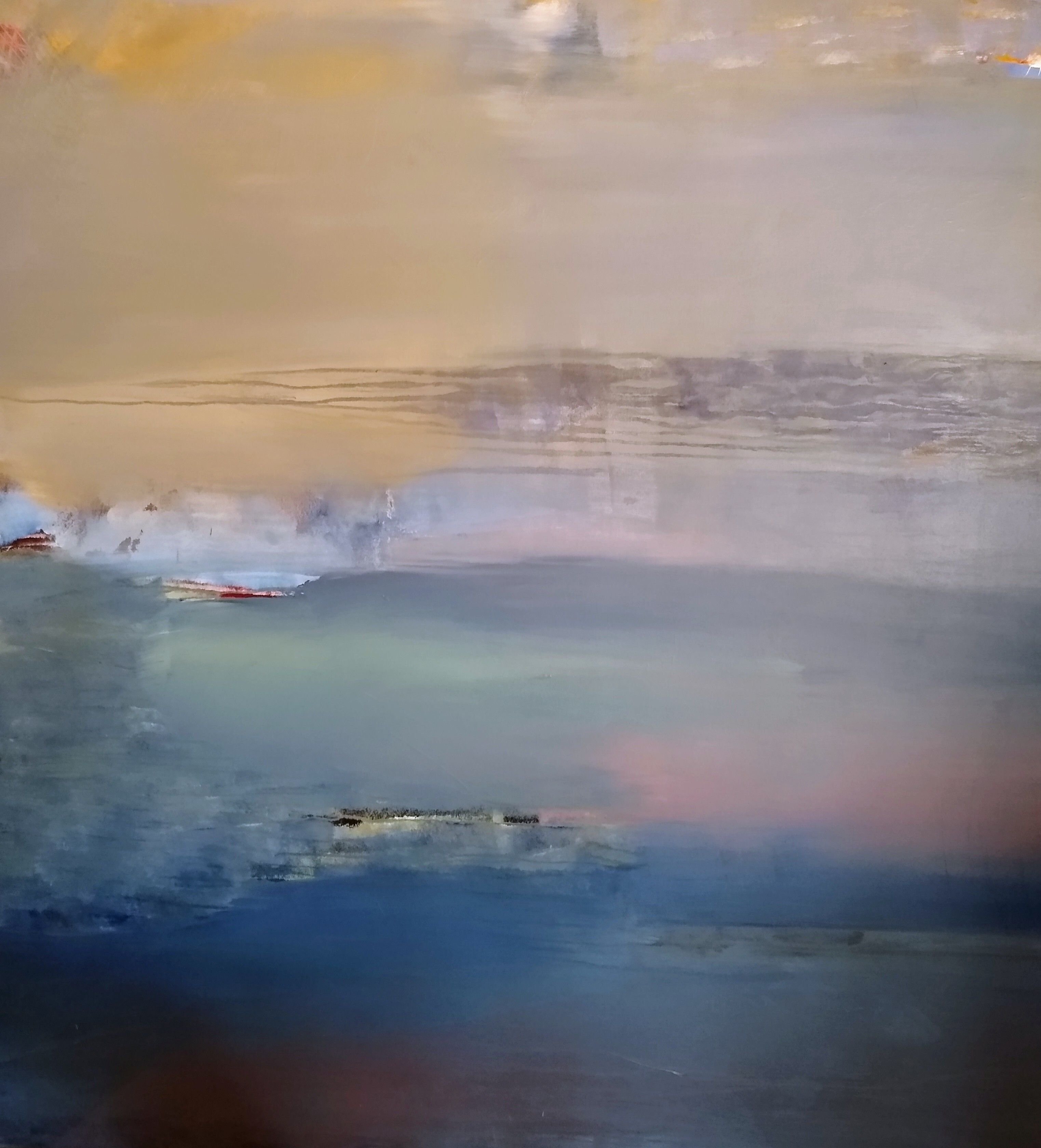
Look deeply: every second I am arriving.
Thich Nhat Hahn, Please Call Me By My True Names, 2004.
A true name is an eye within an eye. As the last part of a work’s resolution, it is anything but casual. Naming designates by virtue a special kind of relationship to the work. It is relevant to any profound perception, whether direct or indirect, and in many instances arrives as an unwarranted meaning or juxtaposition of thoughts. However, an impression in order to be real must be expressed. Without expression there is no impression. And these two are not consecutive but spontaneous and simultaneous. As soon as the impression begins the expression is there at once. As long as the expression continues, the impression is active.
This may suggest certain unique properties, associative information or metaphors to some condition hitherto unseen. However, rather than applied as a label that tags the surface, the name of the work is not a definition or generalization but an action open-ended and relevant as it is revelatory. Relaxed rather than forced or formal but happening by chance naming is an act of self-presentation. Remnants of expatriate meaning giving shape to something beyond the positing of the work. Essential not to mere convention or habit but to the essence or “soul” of the work. When a work is named it has the receiving quality of what it describes. It is an important way in which the work is “passed on”. The receiver whether artist or viewer subsequently becomes a giver in this process of self-illumination.
Names carry great weight. They can be magical in their accidental affinity or coincidence. They can be prudent and poised, obstinate, serious, or playful, even shouting at the viewer from a moral high ground or quietly whispering of integrity. Needless or foolish if fastened to the work like an ill-fitting necktie or a skin grown over the work that robs its revelation or misdirects rather than crowns its transmission.
A crowning name completes the work. It does not fix, cap, or determine it. On the contrary, truly representative naming opens, not closes the work. Naming is a finite situation yet with the assumption there is another dimension to be explored. It channels perception, highlights the work by giving it a sign as self-intuition. A position of symbolic order as a life of ongoing interpretation revealed between intertwined dimensions.
Naming is mysterious. Not the singleness of meaning that denies the inherent multiplicity of the image. Not the analytical, conceptual thinking that relies on literal and distant pseudo-identities. Not on agreed upon definitions so all who stand before the work understand its “meaning” in order to walk away in comfortable self-important finality. But a name that is unrestrained as a radical resonance. An act of consuming creativity that stands out against a backdrop of lesser acts of looking because it comes directly from beholding eyes opening like ponds.
Naming endeavors to grasp the other side of meaning, to underscore the aporias around which the work was created: contradiction, disjunction, deviation, and doubt. All which is to move away from the initial pull of the surface to the liquid indeterminacy of forming relations between singularity (image) and multiplicity (interpretation). Not subject to limitation but potentially to encompass everything that exists or can exist. A process of unfolding that renders with an effusion of energy and the very possibility of insightful response of the already existing but hitherto unrecognized work. What I would call the telegraphic seeing of the lining of the work: the eternal and the unexampled.
Names are of course after the fact. That we and others can apprehend painterly actions and feel their value and significance without need of meaning is inherent in our sensibility. Once a work is defined it loses the ability to be something else. It loses its depth and dimension. It forestalls further creative performance. However, seeking other ways to look at and explain the work to oneself, though interesting and even profound and poetic, naming is not to seek control over the work. It is to transform the work further by experiencing the free flow of imagination rather than to create a wall around it of monologic meaning. The work’s “true name” is not to improve it but to ride on its own glow and growth.
This is far from de-sensualizing (Sontag, Against Interpretation). The intent to name is never to hinder, “surrender,” or disinvest the work that has claim on our souls. Naming is beyond facile elucidation. It does not take the work for granted proceeding into the stables of conformity and easy appreciation. No codes or rules or plucking a set of known elements that is more translation than exploration. Naming is not a designation to be a tourist in our own reality. Naming is a medium, like the process of painting, for self-transformation, the emergence of something new. In a soundless instance, the work manifests itself in fragments and finitude, whole and intact, opening onto an omnipresent endlessness. What Walter Benjamin called “aura” as a source of authority and association (memoire involuntaire).
Far from constriction naming gives the work room to breathe. Emptied of your own presence marks the beginning of a silent dialogue with the work. It is the core of language, making the work palpably seen, not just visually but “audibly.” Releasing the silence trapped within the work it is free to rejoin the silence of the apprehended Absolute eventually annihilating any and all extralinguistic activity. A naming that is as old as faith.
In the beginning was the sound. Two thousand years ago a signature tone called into existence our universe. Abracadabra! The Name, or the unknowable Divine Vibration (Heb. haShem), pressed out the Aramaic words Avra Kehdabra, “I will create as I speak.” The indication of seeing no difference between words and things as the Hebrew for “word” (davar) is also the word for “thing”. Words are no different than physical objects. In mystical Judaism naming unveils an inner dimension of communication. Accordingly, naming means both “made known” and “pronounced” as well as “separated” or “hidden”. A duality that represents both lifeblood exposure and the eventual distance from it.
The symbolism of names cannot go unnoticed. The epitomizing of a name makes a historical, cultural, and personal connection to the named. For example, in Dostoevsky’s Crime and Punishment the protagonist’s Russian name Raskolnikov is highly telling as he is a “schismatic” or “divider.” Not only in literature but in most religions special care is given to naming as names evoke, declare, or speak to the nature of a person as it is said, “On the throne of each soul is a name”.
Origins are hidden in names. Calling them compels the response. In many traditions we are told Creation stands on a name, ineffable and intrinsically mysterious like God’s unpronounceable Name given form as the Tetragrammaton YHVH. The name of God said to be all the letters of the Torah sounded at once without interruption! Names that should not be taken as labels of convenience as addressing the work by name brings life into being. Not unlike waking a person from sleep by calling her name.
Kabbalists held that there is an important parallel between language and life. Each letter, verse, and descriptive mark is comparable to a living organism. In the ancient text the Sefer ha-Bahir (“Book of Illumination”) attributed to the first century sage Nehunya ben HaKanah we read: “The name of a thing is that thing itself”. The view that created things have a linguistic element that may be partially or wholly concealed in its name. When the correct or true name is channeled through the work it brings full attention to the work. It gives it not just life but presence and power.
The action of putting the correct name to the work is an outward rectification of the style of its presence. The viewer who welcomes it serves the work by standing in front of it waiting. “Dreaming” the work while awake takes the work from a low voltage to a high voltage that unblocks and reverses bias conditions, literal-mindedness, and single direction movement. Not only does this assist the imagination it adds value to reflection. Of course, there is an argument to be made for not naming. If naming the physical work is disregarded there is more of a tangible and tangential focus on the painted surface. Naming could create a distance and make the work seem inaccessible and unnecessary, even desecrating any possible communication.
The use of apophatic language, for instance, can underscore and strangely animate the work into speculative interest. Apophatic naming, as in the case of Meister Eckhart who said Gott ist namenlos (“God is unnameable” and therefore omni-nameable), is such a way of describing something by stating what it does not have or something one feigns to deny. It is an attempt to describe what cannot be named since everything said would be inadequate.
Magritte’s This Is Not a Pipe is a visual representation of a pipe although the name of the work tells you it is not so. The idea that representation is not between an object and its image but between a sign and what it signifies. Language is neither the signification of things nor their simple expression but a mental construct and cognitive dissonance: the thing we see is both real and not real. Although we might agree this comes down to a poetics of “non-knowing”, we should recall apophasis (Gk.) means “denial,” a combination of “other than” and “to speak”. Using this definition as a means of “non-naming” becomes the way language brings the work into the sharp focus of being, ensouling it with a profound philosophical foundation. Charles Bernstein writing on the poet-artist Jackson Mac Low’s aleatory (chance) work (2004): It is never a question of deciphering, since there is nothing hidden, obscure, or purposely ambiguous. The difficulty is not like that of figuring out a puzzle or interpreting a dream but of responding to the virtually unassimilated, the nearly unfamiliar, and the initially unrecognizable.
Through the relationship granted by language lies the grasp of the form of the work, its potential not its conclusions. The name the work carries and preserves its presence beyond time’s erasure. The act of naming that makes the work not just present but fully present reveals the human place where it stands, when and on what conditions it yields meaning as well as the inner reply and degree of life inhering in the work. A work larger than its creator beckoning to whom it gave birth that lives by its solitude yet arises, links, and differentiates it from other works. A movement of difference that affects its very construction thereby enforces an inner rupture. An attempt toward self-definition, a sustained contrast from what it is not.
This is all good. But good is the enemy of the better. Look past at what your eyes can see. The enigma of naming is a contingent event of universal compass. To declare its destiny by giving presence to an absence. However, in actuality there are no names, only depths.
Naming strikes nullity with a textural making where you vanish into your own infinity.
Comments