Memorable Mutualities: Dialogues with Your Work
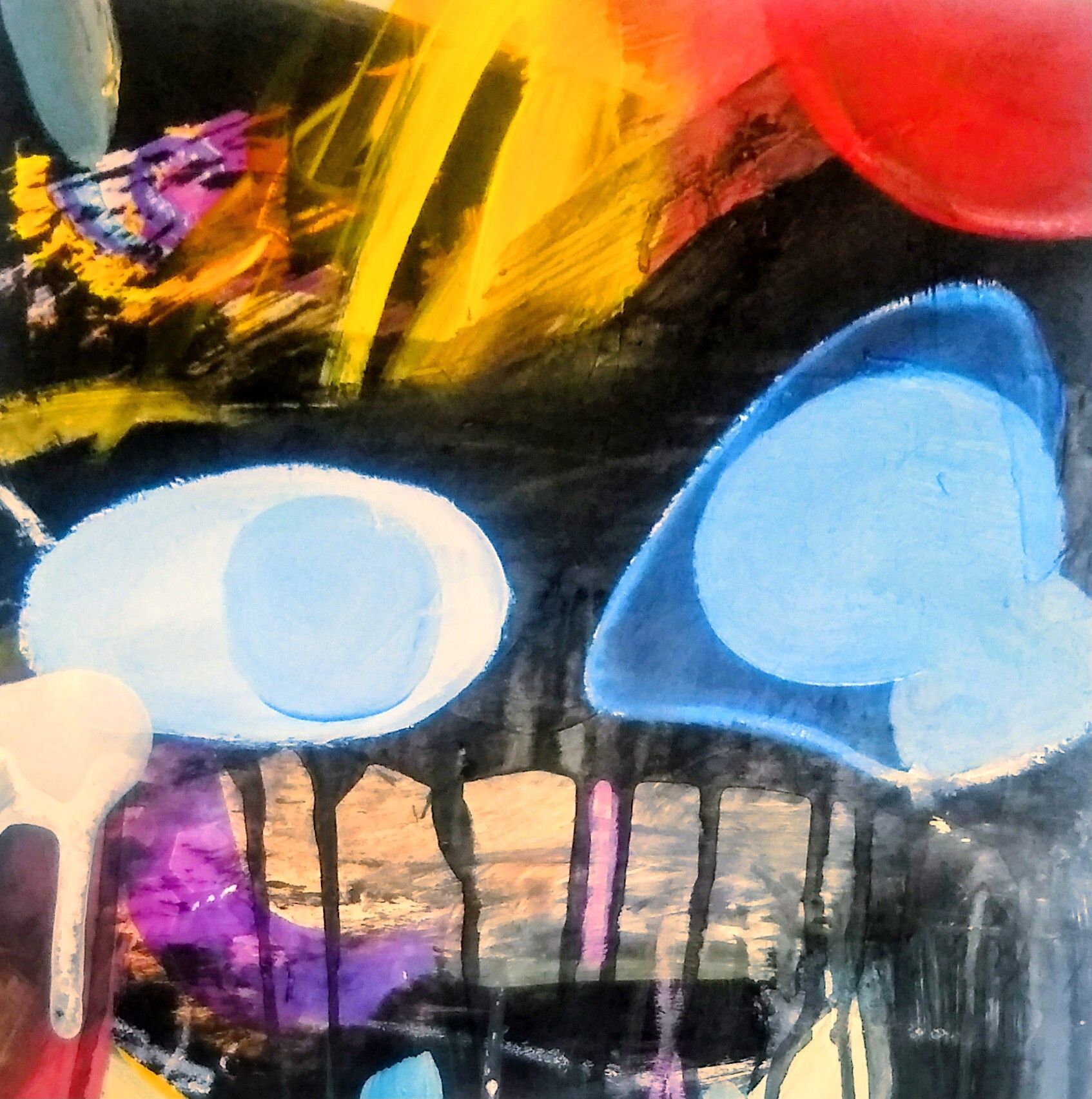
In his novel By the Sea, Nobel laureate (2021) Tanzanian-born British Abdulrazak Gural writes: "I speak to maps. And sometimes they say something back to me…This is not as strange as it sounds, nor is it an unheard of thing."
The unknown within and beyond the Work sleeps quietly in the mirror of perception. A dialogue in the waiting that reflects a very specific action to be taken above the play of images and the excitement of presentation. A way of re-entering the Work that is nothing less than a visitation as the search for the hidden fossils of ourselves. A twin understanding: one that enhances vision, and the other that notices new interpretations to be nurtured. Everything that needs to be known. Of all, umbilical in arrangement and color.
The hermeneutic code, so to speak, that is both source and key to dialogue is inspired by philosopher and humanist Martin Buber (1878-1965), twentieth century's most creative thinker, and his conviction that it is when we come into "memorable mutualities" we open out into the world. Buber claimed: "I point to something in reality that had not or had too little been seen…I open the window and point to what is outside. I have no teaching, but I carry on a conversation." Through the gate of our comings and goings, in moments of self-doubt and wanting to understand our Work, meaningful dialogues act as a portal to provide innermost growth of artist and artwork.
"Dialogue," (Gk.): logos, "word" or "meaning"; (Gk.) dia, "through", "across" or "between"; or dialegesthai, "converse with" as a literary form like Plato's philosophical discussions. An exchange, conference, communication or simply a conversation that brings to light newly found ways to speak. An openness that will transform attitude to insightful understanding. An understanding that precedes interpretation and worn-out conventional wisdom. A rejection of straight-jacket intellect and its fixed structures and categories that is the only reliable way to make sense of the Work and the quality of its presence.
Dialogue is a mode of communication, a creative and radically different way to response to the Work and the understanding of consciousness. The very act of deeply seeing the Work becomes a form of listening. As dialogue in which one inquires with sensitivity into a particular question or phenomenon with simultaneous observation. An effective means to meet ourselves in the refiner's fire of creativity.
A joint process pointing out things to be examined, in order to give genuine potency to image-making. Artist and Work "talking things over together." Listening to what the Work reveals and responding. Never one-sided but a cooperative act of scrutiny and study. Looking, and listening to rising thoughts. A dialogue that requires not only visual perception but attention to the particular that may or may not be interrelated to other issues. Observing the dialogic activity, one gains insight into the whole structure of thought and artmaking. When any portion of the Work is amplified in this manner and coherent light shines upon it, a fragment can reveal thewhole when seen with insight. Once we see the whole, we know the essence of all the parts.
We articulate between art and inquiry, between method and psyche, between the moves that are dynamic processes that correspond to the "fixed" imagery and fluid nature of post-studio practice. The "voice" we must listen to discover things not considered, anticipate, or foresee are root ideas, interests, and attitudes. They are diverse and timeless with many sources. The direction of soul travel these images take are in content, tone, and style. The unifying hermeneutic center as the living reality of the dialogue its ramifications. Something new that might be revealed or something one knows already on a more conscious level.
How we apply words to what we see is paramount, but more importantly is how we live and love them. A turning toward the Work at the same time listening to it. A performative function without rejecting interior interruptions of meandering thoughts. Words and forms in relation to memory. Their significance whether verbal or visual, the impulse to raise questions, regenerate alternative and sensory ways of seeing regarding who we are. To continuously discover our human authenticity through studio and post-studio practice.
Turning toward the Work opens it. Not to any predetermined or guaranteed satisfaction but as a reorientation away from the ego driven. Because it is dialogical, inherently participatory, it is present in body, mind, and spirit. A "meeting," [Ger. die Begegnung] "encounter," "engagement," "match," implying something unexpected or significant, chance, coming face-to-face with something or someone.
Turning toward and addressing the Work in mutual presence is to realize its potential gift that gives new life.In accepting the Work as it is in the moment of seeing, self-becoming moves into the future carnival of images. Being attentive, responsive, and authentic in partnering we reidentify. We boldly become Each-Other in vital reciprocity and mutuality. Changing the course of direction, no matter how small or large, whether we are in the early stages of working or resolving and concluding the process the response will determine not only how we begin but the direction to take. Dialogue as "participatory consciousness" in the words of physicist David Bohm (1917-1992) allows us to see the mythic edge of our Work and perhaps, if we go deep enough, to look into the jaws of archetype.
Accepting, affirming, and confirming the dialogical partner, even when doubting the process. The action is in addressing the Work. More than writing our name of ownership on the back of the canvas, "addressing" is both "talking to" and a stance to "set upright" and "guide" prior to conversation.
Addressing means adjusting a space for the Work to become present. To repeat: listen to what has to be said. Turn away from self-focus and give complete attention to presence. We do this by accepting the Work at whatever stage of completion and present ourselves to it with a "shared language". Finding primary words that respond,capture, and open it as in discussion. Moments of relation is where we find them. It is what beholds us. And what is beheld, recognized, loved. Not through the lens of who we seem or what we want it to be but accepting the Work as wholly unique whether mud or matter. The Work as a transfer of meaning, a potential intuitive vision, "home-born". A "vernacular" painting but not superficially culture-driven, not "fadnoo".
Deep empathetic listening is required while the Work is speaking. Listening to what it tells us is an important step because as it "expresses itself" we imagine a new and different wholeness and unity. Tuning in, taking notice, heeding, observing, and taking into consideration one's attention. Responding, answering, reacting, replying, feedback becomes a way of "pledging again" the commitment in the form of questions raised, answered, and insights regarding studio practice. Responding is being responsible and answerable. Fulfilling our obligations as an execution of trust that is the potential for a "dialogic awakening." What could be said that would remodel studio practice, self-critique at the end of resolution? What is the "operational motive" of studio practice? Posing questions listen for responses. Listen obediently. There must be a willingness to learn. Finding meaning in active listening is paramount. Suspending judgment, resisting distractions, pausing to seek out what may come back through relational grace.
How we listen in a dialogue not only depends upon the state of attention, but on the state of silence in which the whole background is in abeyance. In the way we note the intense stirring, the imagination rising. Conversations heard and not heard transfigure their designations. A wandering dialogue, a nomadic perspective and economy of refence take the form of many interpretations. It is like looking and speaking into the mirror. When we respond honestly to what we hear ourselves say and see, we begin to re-evaluate. To honor what we subsequently will do, we respond with authenticity.
Dialogues that breach the ego rely on words and phrases that break through shifts in process, mood, tone, and attitude. From the perspective of the psyche the Work is the imaginal guest. Hidden, overlooked, sometimes with false meanings. Any and all subtext that clarifies difficult sensing and speaking about the Work from coherence to dissonant thoughts and feelings. Explicit narratives that fill the lack of self-knowledge. A process which unfolds continuously in different ways to bring forth the potential within us.
Pivoting from the fringes of the constricted self, from the places we spend most of the time, use most of our energy, towards the Work waiting for our attention. By pivoting we create new narratives regarding our Work and life. We scratch out an active relationship that is the pivot itself. A conviction that allows a space of mutuality of connection. Inquisitive, open, and attentive to what lies beneath the surface and the sacramental possibility of moving beyond ourselves. The energy that comes from listening to ourselves in what we have to say that translates the "reality" of the Work from "it" to "us". However, this should only be done prior to any designation of naming or categorizing. Otherwise, a barrier is constructed between creator and created. Reflection on our painting is replete with the sense that it has something to teach us. We enter the composition and its existence asking ourselves not only "what do I see?" but "what does this truth teach me?" Twin under-standings of the process, one that sees entrances and the other that sees the quest for new interpretations noticed and nurtured.
An invisible membrane separates artist and Work. But actions of the kind in which I speak must be genuine as well as technical for objective understanding. Artist and Work meet in a space openly attentive to one's voice, willingly nonjudgmental and vulnerable. We note our insightful responses to questions as well as reciprocal responses revealed. To a possible "conversion" event that is a reorientation of openness in its unreduced immediacy.
Authentic meaning does not necessarily originate in the eyes of the artist alone but arises in the oscillating realm of the between, in the imaginal where interaction embraces both artist and Work. Links connecting personal life, visual insights, and recognition. A dialogue of voices and sightings. Voice speaking through us, personal speech heard and challenges felt. Unleashing thoughts, reframing their parts to the whole, in a new way to radically see what it is we must see. To show not only the path of origins but the significance of the encounter that is to come.
A cursory "taxonomy" of dialogues might look like this: an outer dialogue that is between artist and Work, an inner dialogue consisting of our thoughts, emotions, etc., an indirect dialogue that is a summary take on the Work, a monologue or soliloquy speaking at length as if we are a character in a play, and telepathic/unconventional dialogue that is the revelation or visual recital of the image. However, using dialogue "tags" might be easier and quicker, succinct or abbreviated words and phrases indicating clarity, establishing tone, conveying emotion and subsequent responses.
We wrestle with the Work. A grappling dedicated to the meaning that arises in the present moment requiring careful attention to what comes up in mind, spoken and not spoken. The intention to follow thought (meaning) as it winds its way through the dialogue. Things presenting themselves and connections not far behind, if not immediate. Each contribution is a distinctive expression as we relinquish control in our attentiveness. In the yin inquiry, that is a contemplative, slow-held exploration of inner states to foster self-understanding and emotional release, we swallow the self to uncover and move beyond deep-seated patterns to the outer limits of the archetypal.
What is needed is a conscious direction of awareness along with a source of energy to infuse studio practice that is attentive to the origins of thought and the desire to dialogue. A primal voice in which past, present, and future practice has a viable paradigm for working and a reconstruction of approach. Being aware of obstacles that stand in the way of relating to studio practice without preconceptions. To bring what is distant into the present. Engage, reflect, absorb, challenge, feel, imagine, think, and critique. Shifting perspectives, keeping dialogue fluid and loose starting with the "end" or completed Work, moving backwards noting sequences of patterns and passages of painting, any and all contingencies up to final resolution.
The transcending voice of dialogue is the relational event that creates the conditions of appearance. When we speak from selfless-being, without reserve, spontaneously awakening seer and seen, there is no room for suppressing longings, pimping commodities, pushing products. Dialogue casts light on the blind spots of seeing, challenges the encounter and re-engages what is unreserved and understated. In dialogic practice theunmanifest has precedence, tongue and heel in emptiness. What can be seen is nothing in the face of what is not seen. In the scattered light of expectations multiple levels of attention are requisite for where we are and who we are. We become all things not by understanding them but by transforming ourselves into them.
The result is awareness. Awareness that reveals depth, complexity, mystery, and enigma regarding the overall creative process as well as each stage. Perception of the language of symbols allows us to become the mirror of self-disclosure. The spiritual contour or recorded memory of the development in which engages in conversation with all other efforts as it were, a constitution of the psychic regime. Consideration with utmost regard this transcendental cast increases inner freedom giving us the ability to see what needs to be done. Mirroring consciousness provides the center of our elenctic self-examination in living conversation. Ascending the ladder of meaning until image becomes presence.
Listening to ourselves we also realize that conscious dialogue is only a small and fragmentary portion of unabridged willingness. It begins with the command from side paths and dead ends to respect all agencies of authentic purpose and meaning. As an organizing rule "respect" means "to see again," implying "to be awake". Respect comes first, then time and effort, and love for the gift granted. In this manner, speaking is given spatial existence; a true account distinguished from the wreckage of reason. The underlying liberty is in the eyes of our ascent towards the immediacy of meaning. The mother of the moment is the matrix of possibility.
We follow our visionary recital the way the heart traces a bedazzlement.
The way a star is caught in the hair.
Comments