Language of the Face - The Revealed Abstraction
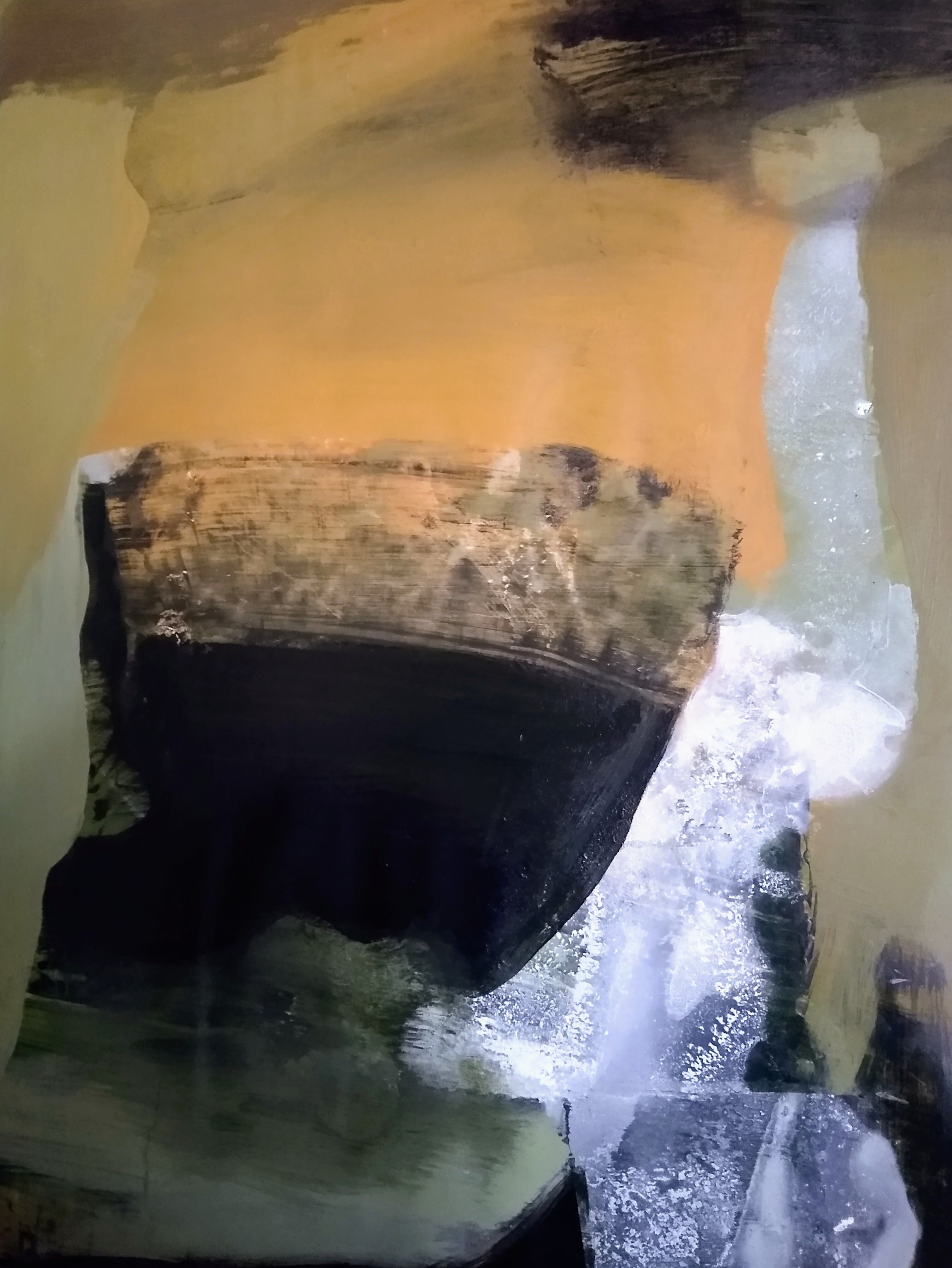
May 2023 - Language of the Face: The Revealed in Abstraction
I witness the Face as it emerges from the void of my creation. I see myself clearly as if in a calm afternoon sea. I sink into myself, deeply looking inward and outward at the same moment. In snatches of reflecting light, in the many moving shapes and colors is a multiplication of contradiction and self-knowing not bound to time and space, memory and recognition. They adorn themselves, wait for me to come and root them. In their beautiful shadows I stretch out and see that Otherness present, the inscription of wholeness that makes me think of autumn beneath absorbent skies.
In the depths of our inner sea, we are given to find our True or Original Face. We who face the world everyday extend our horizons in a correlation of realities that is psycho-spiritual. In our magnetic looking we witness what we are, our vision and its worth. The root-metaphor of Face could be anything we struggle with. But in our case, as painters, it can be a metaphor that helps us understand the body of work. It will be in this light of a truth offering freedom that we can incarnate. Whatever it may be, it is something inherently beyond “rational” thinking. But if we experiment with how we see, if we are fully engaged, quiet and passive, insight may come swiftly. As a supersensory sense, we can mirror the Face emotionally and intellectually, distilled in our suchness. A direct perception rather than in a reasoned or seasoned conclusion. True alchemy that can transmute not something into something else but something wholly into itself.
I sound an urgent call for change that seeks another way of looking and thinking about the painter’s path. A sharper relief on a more differentiated plane. The radical transformation of the meaning and value of the work that comes from a beholding of our conditioned, negative reflexes.
When we are alienated and exiled from the Face we suffer a work that is colorless, without content and self-recognition. To uncover the Face of our work one can discover neurological constellations as a network of nerves communicating and pulsating along axions and across synapses. But it is in the sense of a close encounter, an intense awareness that an intoxication grips the soul and transforms a hollow tongue into a human being.
The Teaching: The Face and How It Is Revealed in Abstract Painting.
The face (an image with a lower-case “f”) is a simple and direct word applicable either to one’s own or another’s face. A face that is the front part of the human head that includes the mouth, nose, eyes, forehead, and cheeks. The physical face.
The Face (an Imago with an upper-case “F”) is the countenance, visage, the look, appearance, aspect, or singular expression of the work. The uncharted path beneath and beyond the surface, the root image with its iconic stare. The Face outside habitual seeing. The expansive personification or the embodiment against an increasing rigidification, superficiality and commodification of the work.
The frame and orientation toward the work is the beginning of a startling transformation of both outward and inner perception. To recast the way in which we look, think, and speak about the work that allocates parts to different selves or “performers” so as to radically remold everything that can bring about a revelation in mood, contour, color, and shape. An expression directly significant and indelible, a force-field that encloses the truth about life – your life.
Breaking the vessels of the old ways of looking, we seek an active attention to the simultaneity or multitude of impressions leading to a deeper scrutiny. One that displaces the worn-out facade by a hitherto unimaginable interior geography. A process with an inner rigor beyond the range of its own position. A meta-morphosis, countable and uncountable, where the development of one thing morphs into another. The feeling of correctness.
This Face is our Original Face. With the substitution of a literal for figurative language, we may come up with a thousand countenances each with its own reality, each exhibiting nearness or distance, alienation, or intimacy. A manifestation extended by means of techniques, materials, insights. A splendid panoply of things revealed or drawn upon. The prosopon(Gk. “face”) within the disc of darkness of one’s soul.
The Face of the work satiates us with presence or distances us with absence.The Face appears with a view to conveying distinct attributes. It has its own topography as a performative artifact. The nature of which is a visual recital that invites not only participation and contemplation but an intimate knowledge through its immediate form. A subsequent recollection and inventive redeployment as a key to understanding oneself and one’s work. Outward emanating as it is inward receiving that tells us not simply what we see but the way in which we see.
Esse est percipi, “to be is to be perceived”. This is not to make the Face an ego phantom. For it is the deepest images we seek, the Face of the image that wants to be revealed, to spread out, to be known. The brood of desire that is the fine frenzy of rolling with things unknown.
Image-making is the gift of dreams. The strata of reality infused with an inner force that is transcendent. As a living presence and a conduit, it is not a complex lattice work or screen intended to conceal. Just the opposite, it stimulates the potency that is within us. It allows us to encounter ourselves and our world in acts of arraying, establishing, enhancing, embodying. Alerting us to a unified multiplicity that makes oneself the object of contemplation. It eclipses the ego with visual, mythical, sensory, psychological, and erotic challenges. A corporality that is subtle and complex as any meaningful dialogue. Complete and proliferating as if nothing else ever existed.
The first step is a face-to-Face gazing as a thought, feeling, or experience. The second step constitutes our response to engage in the depth dimension presented to us. Of course, the gazing is reciprocal and depends upon what happens first. There could also occur a Face-to-face gazing or a simultaneous (“Cubist”) gazing.
The gaze, intently and steadily, embodies certain aspects of the relationship between observer and observed. One’s encounter with this otherness turns us toward a language of relatedness and interconnection. It may bring to mind the importance of going beyond the surface on which we describe the work only in terms of appearance. In the gaze are infinite worlds that exist beyond the boundaries of art-speak.
Here is a new dialectic of gazing. In biblical terms as the Lord knew Moses “face to face”; or Paul in 2 Corinthians (3:7-18) who says Jesus lifts the veil from our faces to see God’s glory. A reflection “bent back,” stretched perpendicularly for us to see new ways out from the labyrinth of ego-existence.
The constant gaze between these two entities – the Face of the work and one’s own face – is a coupling that enables and ensures not only the continuation of self-transformation of both object and subject but may provide the psychic agent for the reassembling of our lived present. It is a “dual consciousness” that is in a state of motion when one face is turned toward the face of the other. A face-to-face gazing that is a renewed and reoriented focus. A process of drawing near to the living connection between oneself and the unknown that exists within us.
Oscar Wilde in a letter to the St. James Gazette said our inner self, our true nature shows up on the surface of the canvas. He was referring to his philosophical novel originally published in 1890 The Picture of Dorian Gray. The portrait central to the novel becomes a living allegory, a visible interpretation of the inner self when one pursues the body over the soul.
It is a necessary and urgent project to re-vitalize how and what we see. To discover new ways to reopen the work. To deepen it and to nourish the dimensions from which it has been consciously or unconsciously estranged. We must allow the Face to be suffused with the plentitude of meaning and the assurance of a fuller and richer connection integral to the body of our work. The Face that perceives us, creates our responses, pulls us into an inner inventory must be a cluster of multiplicities beyond our last thought.
Understanding the language of the Face reveals the spring pool beneath the threshing shed of the commonplace. The site of our self-shaping is the procreative foam of our metaphors, symbols, and analogies. Specks that soften the confoundment of the terrible and breathtaking enigma of human life.
Comments