Composition By Field
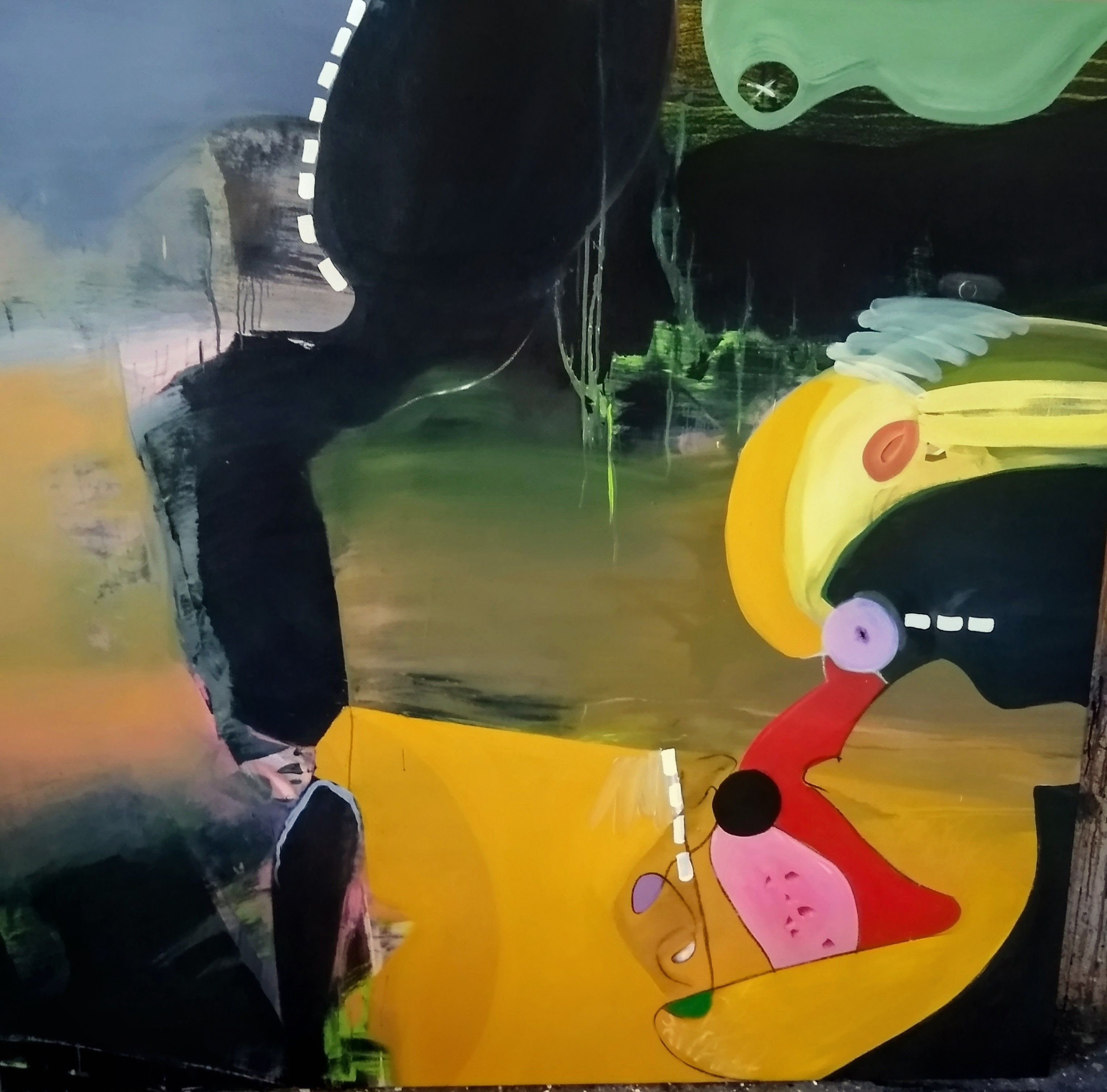
Composition By Field
Composition is a map of sorts, a visual artifact of the continuity of the painter’s navigational surface and mundus interior. The schematic view relying on the idea that structure and layout as well as configuration is a placement by field. The symbolic representation of a system or process defined as open and as a continuity of units. Chaining together visual pathways or concatenating trajectories from point A to point B to point C that are fluid sets of multiple starting points. Functors of a kind between areas or “wrappers” (i.e. of an earlier structure) resulting in a new composition that allows different spaces and shapes to connect, overlap, and loop around one another. Deliberate and signifying something that is and remains a given situs in space. A topography of the visionary state as a departure from external reality and the faculty of perception belonging to it. In a sense, composition as field is a performative presence embedding an absence that requires filling.
The journey of the image from two “deformed” images to a composite, documents the fact that to see as an artist is a seeing to compose. The direct link between seeing and composing that permitted Gertrude Stein (American novelist, poet, playwright, art collector,1874-1946) to assert, “Nothing changes from generation to generation except the thing seen and that makes a composition.”
From looking to finding, and multiple steps between, the image moves toward embodiment. Concentrated vision inherent in the prefiguring and integral with the sharp focus of the totality or composition. An orchestration in terms of structure and aggregate as the disposition and flow of forms, colors, placement and so on. What Hemmingway picked up from Cezanne as “living with the eyes” that eliminates the inessential as it achieves breath and intensity of the whole.
Even at the outer limits of coherence composition coheres. The organizing center of the field of the painting radiates outward and repeats that universal creation described in the rabbinical text: “As an embryo grows from the navel, so God, in creating the world began with the navel, and from there it spread in all directions.” Or, in the words of the Swiss German artist Paul Klee (d.1940), the self-selected point “sets itself in motion and an essential structure grows”. Giving shape to the work, transcending the purely physical realm beyond the technical, leads to a new vision of process and resolution. Every direction, every layer corresponds to a symbolic orientation that is the foundation for a potentially higher state of knowing. A spatial layout reflecting the aesthetico-metaphysical armature that is a sudden understanding into the extension of meaning.
Composition by field is the exact place or locality where the horizon of intelligibility and context is situated or where something not-so-simply happens. Not just locational, it is the center of activity, attention, or power. Bordered by the four directions, all points, lines, curves lead beyond the frame, or within specific locations. Sets of marker images (or conditions) forming specific shapes, paths, or neighborhoods of painterly activity. However, composition is not determined by the frame but by its “leap” – quanta or jump. Or by continuity toward causation, a perception or memory. An extension that reaches the far side of ordinary limits by impetus and flow. A lure that is emotional, purposive, appreciative. But also new relationships, unrealized and unforeseen that makes their appearance and introduces into the universe new order.
The vibratory or energy potential of the field from which every acted occasion arises, analogies as well as precise designs, contrast and elicit attention. A field of interweaving of individual peculiarities and substantial forms. A feed from beyond to be determined or a magnetic field where painterly action is automatic, fast, unedited, capturing directly what lies in the subconscious or outer spheres of the imagination. Skirting the control of logic but focusing on chance, this region of energy becomes a vector of strength, duration, and direction. A flux of charges along “lay lines”, intuited pathways connecting significant routes or conduits of energy the eye follows. A composition that is an energy grid of power, of fundamental features of mind that comes to animate the perceived world of forms.
To be conscious is to have both transcendence of things and transcendence of phantasms, all of which promises total actuality. The field is the apparatus to form concretions of the inexhaustible. To form existent significations, the precipitation or crystallization of the imaginary that is existential and symbolic. Any slackness of heart takes off one’s attention, that critical thing. From the push of the brush at the moment of observation to the field where all elements are created and managed in their relations to each other. It is a matter, after all, of imagery: not even of how it got there but how it is used. In the structure of illuminated appearances, composition is a horizon to be envisioned. A collection of discrete, self-contained forms.
The differentiation of a unified field not as a sum of isolated entities as commonly thought and practiced but the unfolding of a singular, refulgent reality that is at once dynamic and continuous. A givenness that constitutes the ontological ground of appearance. Rather than overthinking how forms appear to consciousness and how meaning is constituted through intuition, illumination of the field underlies all visual manifestations through spontaneity, reflection, and the perception of the potential between the forms. The perceptual separation making up the “view” such as it is implicated in the reflex of the brush. Make no mistake, conceiving composition as static and non-organic, the anorexia of one’s signifiers, leaves no room for an eventual “knowledge graph.” Or a new presence as an event within a single, ever-renewable field of appearances and rediscovery of the originating contraries across the surface. Like the expanse of the world the composition as such is always open.
Composition by field becomes a web of disclosures arising from the luminous ground that sustains the work looked at. Thus, composition by field is not a passive record of the painterly maneuvers but the gathering function that moves it onto a field, in which the artist’s psyche and the psyche of the world is actualized and comes forth in its uniqueness and eccentricity. A mutual participation that precedes and sustains differentiation yet compels a reimagining of space beyond the inert void in which images are passively placed and situated. An arena where appearance is dynamically articulated and where the composition reveals the ongoing happening of creation.
At this point let’s not confuse composition by field with Color Field painting. Color Field painting is a 1950s-1960s abstract art movement featuring engulfing, expansive, larger-than-life artworks. Characterized by flat, solid areas of color and thinly poured, rolled, or stained paint on unprimed canvas to evoke contemplative, emotional, or transcendent responses. Emerging from Abstract Expressionism massive paintings often focused on “visual purity”, optical effects, and the flatness of the surface over form (See Mark Rothko, Clifford Still, Barnett Newman, Helen Frankenthaler, Jules Olitski, Cy Twombly, et. al). It was a move away from the intense gestural emotion of the mighty brush towards a calmer, more formal visual style.
The field of composition surrounds and traverses us. Vision is in the midst of being. Studio work is encrusted in the joints. It announces what it conceals. Coiling up the invisible, centering on open space or the “field” where elements of interest are free rather than confined to closed structures. Because it is a field of action, it is much akin to the arena of “action painting”. And like “action painting” a goal is to transfer the energy of a perception from the artist to viewer without losing its “charge”. It is the sense of the moment to moment in the process. One perception immediately follows and directly leads to a further visual or intellectual one. It is a way to “throw” one’s insight (i.e. psyche) onto the canvas. The material of the field is weighed with individual peculiarities. The idiosyncratic quality of eventually being itself, resting in itself, is the self-open province of non-Euclidian discourse.
From beginning to end is impetus, the driving force, incentive, stimulus, the energy that compels. There is no form or image until the painting creates its own. Intrinsic to itself each painting differs from other paintings which have been or might have been painted. No statement or rule leans solely on composition, of how it is or what it does. Painting does not possess the safeguard grammar of structure or patina of careful placement. Inventing a new dawn in whatever turns up draws its own light by willful gendering.
Composition can be broken down into rest, velocity, acceleration. Rest that is duration. Velocity as speed or energy is the most forwarding way the composition moves toward re-solution (resolution). The physicality as field is its materia, the place where enduring images are made known. Subject matter and source within space-time where things reside regardless of any limiting factors. It has only one law: to create and retain its own environment. Otherwise, it lifts away…
The inside of a field or region that completes its potentiality is the spatial and temporal aspects of extension. This is the field in advance of everything that comes to be present. A “district” organized within the composition both as a physical space and in meaning. To engage in painterly activity with choiceless application. Most importantly, a field, region, area or space as an arena of life or personal history both unique as a mode of being. Space (or spaces) of significance, such as “there”, “here”, “over there” anchored in how the artist acts and works. Open to work and observation, a clearing that encourages specific images or themes to appear.
Profoundly, it represents the place-nature, place-being, or energy-locus. It is also a metaphor for a bounded or limited area to “complete”: the field or region monitored during the process of painting. To be circumspect, literally “look around” to take in the encounter of occurrent images and properties. It is also the instance of holistic context that is articulated or being articulated as an invitation to act. A network of affordances of a situation that, if awake, announces itself.
Composition as field is an extension of content, in that one perception directly leads to a further one. A projective field that rejects fixed forms in favor of actions that are immediate, energetic, and physiological. A paratactic notion of “studio practice” that is the direct transfer of energy from the artist. A way of working that discloses itself rather than mired in a “having been” of the past. A view that is not a step-by-step construction because it is energized as whole. Where form turns into a high-energy series of “placements”. No “project” to pursue, not something one does among other things. It does not focus on any static object ignoring the dynamic, interpretative nature of creating. It discloses (or withdraws) itself as the event of appropriation, opening up through actions the visual language of form and color. Breaking the rigid framing that limits possibilities of perception as a reserve to be consumed.
As space of the canvas is both positive and negative it is also projected. Space is dynamic and punctuated by forms and shapes that give the composition rhythm and tempo as in a musical score. A move away from treating the composition simply as physical distance (perspective) or capacity (minimum or maximum, a placement for “stacking”) but as a “living” area of high energy distribution and points of energy-discharge. A view of the canvas as a sequence of processes as riff, rhythm, and hook. A propulsion that transfers visual vibrations from source to viewer.
Projected by the immediacy of content and emotion rather than forced into a conservative predetermined mold, a composition that is not closed but is spontaneously forthcoming. Aligned with the lived experience and personal sensibility by the forms that inhabit it rather than self-secluding and sheltering, an “open field” composition encourages what might emerge in terms of feeling or meaning. The artist being “thrown forward” by the field equivalent to the discharge. The power or drive that is the extension of content under the entity of the brush and the “negentity” (representing the spaces, absences or invisible backgrounds) of the canvas. But other extensions are lying in wait as well.
“Projection” of the field is understood existentially: how human existence perceives itself in terms of possibilities. Not the conscious, planned, or subjective projection of values but the fundamental mode of being pitched into future promises. An ecstatic temporality rather than logical understanding. A calculation that brings forth new insights outside of linear time and “arthood” for the sake of authenticity and significance. Not simply an aesthetic experience but an embodied experience through a eurythmic and expressive grasp of originating presentations. The foundation of artmaking that rides tandem with the raw “feel” (qualia) of experience. The introspective, phenomenal aspect and the lurking primal disposition of the unconscious. The pre-personal intensity that advances painting to its proper place as libidinal hunger.
All this is beyond the technical. Painting is instant by instant as it shapes the energy and advances the form to its proper place. The shaping that transfers the energy of the process to the looking that is equal to the acquisition of the eye that sees. A kind of “vernacular” painting that does not possess the grammar of structure until it does. Its density from which and by which it draws its own clarity that is individual and peculiar. The management of materials so they tilt, hang, lean, rise or ride within the space. Heterogeneous elements brought together in a more profound and inner reality.
Composition by field has a single point of origin. Its substantial form in the midst of physicality of its energy-locus becomes the narrative of the event. As it is essential in unfolding new ideas and techniques, the field is employed directly as things are placed in juxtaposition. Though transitional and against the sedentary perception of perspective, it demands at times reckless inventiveness. It is an internal as well as external phenomenon - the folds of the soul and the pleats of matter - as the power rises both from within the painting and outside it with the painter.
Understanding composition as projective field permits active transition, the energizing power of movement, and the viability of the changing surface. One in which to act rather than a space to construct, reproduce, or re-design. It produces no picture but welds flux to current, experience to precept. Jackson Pollock: “I have no fears about making changes, destroying the image, etc., because the painting has a life of its own.”
The painter’s job is not to dominate the field but to interpret it. The painter is the “reciter” translating the light of understanding into workable measures, steps, or tactics. In this respect, each flow of painting is a revelation as it is a reconciliation. Knowledge gained becomes service to the creative process: the restoration of transparency between image and essence that is both “cosmic” and “eschatological”. As a cosmic field it is the embodiment of human performance and establishes the operation of creation. Eschatological in that it carries its destination beyond the personhood of the painter as well as illuminating consciousness. What is unveiled is its radiance. Projection into possibility that at once negotiates the past and situates the present. A revelation from current position by multiple beginnings in the search for new recognitions.
Composition by field is the way of transformation not simply a collection of elements and their properties moved about. It is the feng shui of studio practice in the arranging of specific shapes, materials, and colors of opposing but complementary forces within a balanced space. Compossible, that is, capable of existing or occurring together in terms of possibilities as long as they belong to the wholeness of the field. Not just actualized and existing but happening together in the same place or at the same time in an associated grouping. When mastery bows to mystery studio practice is a sweeping overhaul far deeper and rooted in a radical reimagining that optimizes the flow of energy and balances the seemingly contradictory at a fundamentally unified level of reality.
Field does not denote limits or necessarily confine activities or influences. It does not, in our use, imply restrictions on choice or necessity but is viewed as a clearing or opening that has extension and magnitude. A potential movement of a particular kind and not a static resting place like some transcendental parking lot. By the theory of extension, the commanding position casts projective modes of observation, play, and the heterogeneity of new relations that cause one to feel the change, process, and the repertoire of usable materials that induce the agency of novel advance.
Composition by projective field is the push along the arc of freshness. It is both origin and destination. Quickened by brush it takes the eye of enunciation forward. A restoration between knowing and being, the shared vocation of creation and consciousness without searching for rationalization. An alignment in which the artist holds together the fragmentation of seeing, of being and extreme solitude. A wandering in uncertainty and the embracing of Keats’ negative capability. The mindset of putting aside one’s preconceived judgments to hold uncertainty and doubt without immediate answers or conclusions.
A visual locution in search of location.
Comments