Coincidence of Opposites - The Nature of Correlative Thinking
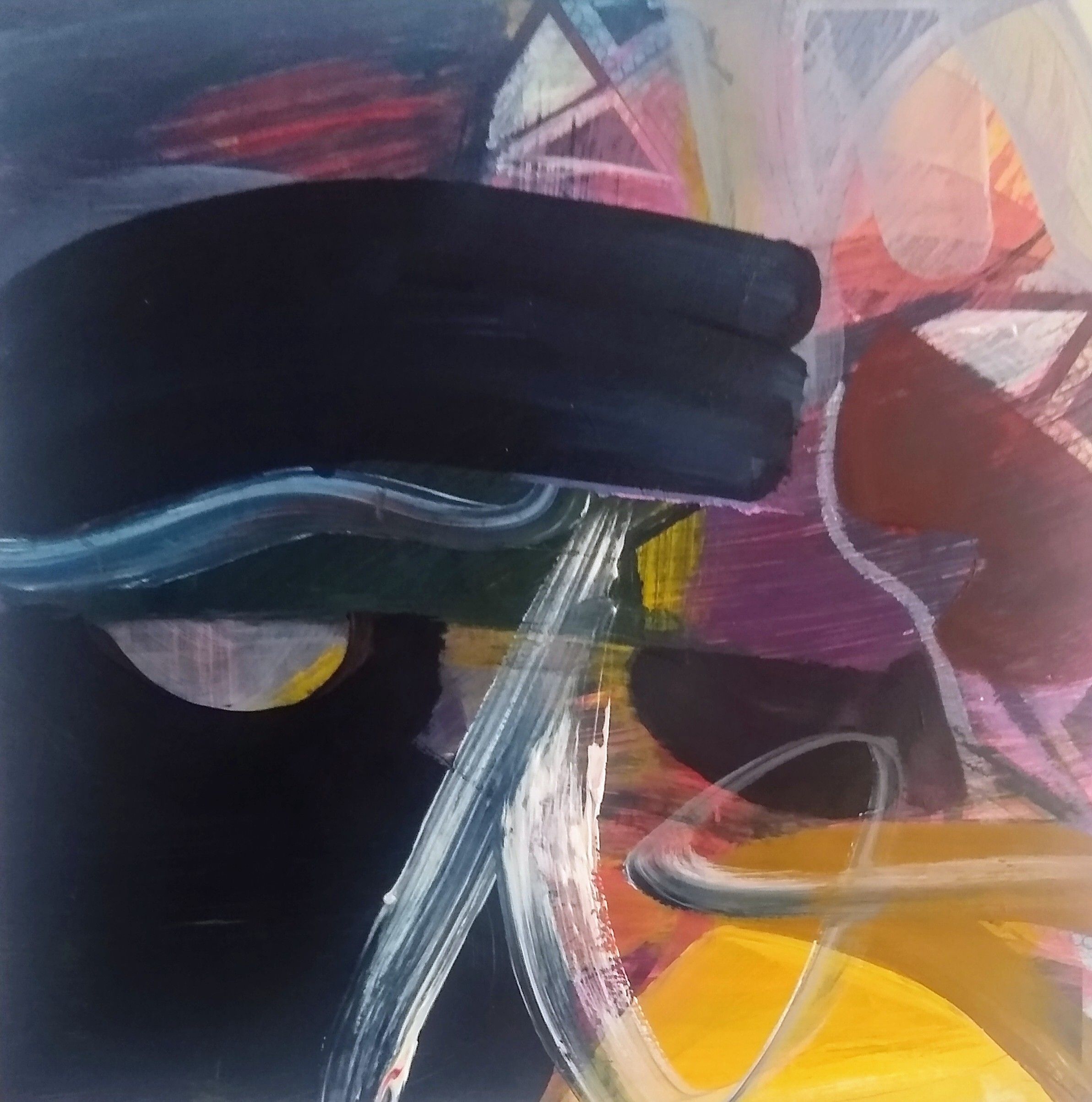
To speak about painting is to translate it. The kind of translation that self-contextualizes a path to advance understanding. Communication with oneself is back to the roots, so to speak, beyond mere looking to see those characteristics that are the revelatory garments in the work’s unfolding.
Combined elements in the formation of the work; permutations, changing and final positions, producing meaningful language. A vagary of metaphorical schemes, values, sensory modalities, transcendent and immanent, complimenting one another.
Painting is a coincidence of opposites. An occurrence of seemingly incompatible coexisting happenings at the same time but having some connection. Between the already-seen and the possible-seen. Shattering of the surface of both mind and work that is a process not unlike the solve et coagula of alchemy, a dissolving and a congealing. From nothing to something, from something to nothing, adding and subtracting, plenum and vacuum.
Coincidentia oppositorum is correlative, separate andintegrated. A both/and approach to painting. It a free action, an accurate application, as physicist Niels Bohr exclaimed, in which “the opposite also contains deep truth”. Most importantly, it is how they are viewed. Distinction is necessary for expression as well as for expressing its own transcendence. In other words, for its unification. In grasping the seemingly contradictory points of view, seeing the work as an undivided whole, of two opposing but necessary forms of energy that are true and alive, is the meta-coincidence between painter’s vision of unity and the work’s formative force of difference oscillating.
The formal achievement of polarities make necessary conditions for their assertion, interruption, tension and intensity. It completes the simultaneity of seeing. A visual act that conditions one another as singularity and plurality. In the words of Andre Breton, a “contradiction surmounted… provoking the total upheaval of sensibility”. A dialectic between two contrary ideas that are in a sense, also, identical. A duality of this and that, they are in a broader view, a “non-dualistic duality,” for within itself is its own opposite.
Johannes Urzidil (d.1970) writes of Kafka: “His real greatness lies in the value of his images. Every metaphor always contains more than the author intended to enclose in it, since an image leads an autonomous existence of its own and – when it is authentic and exact – develops from itself meanings for which, at the time of its arising, perhaps no external reference and motives yet existed.” (italics mine)
A coincidentiafound in many traditions, including Neoplatonism, Tantric Hinduism, and Buddhism, the paradoxes of Nagarjuna, Chinese Chan and Japanese Zen, Daoism, Vedanta, German mysticism, Alchemy, Kabbalah, Zoroastrianism, and Sufism. While its unity of opposing ideas, attitudes, emotions, and impulses runs as an undercurrent through ancient medieval and renaissance thought playing a central part in the work of Georg Hegel, C.G. Jung, Mircea Eliade, Henri Corbin, Gershom Scholem, Levi-Straus, Werner Heisenberg, Niels Bohr, Comte de Lautreamont, the Surrealists, and Jorge Luis Borges to name a few. Reflecting deep truths about the universe, world and the nature of mind both the rational and imaginative modes of understanding of the dialectical, bilinear or multilinear in art, literature, philosophy, theology, psychology, religion, and language. It is an archetypal value.
The first pair of opposites according to the Sefer Yetzirah, a third to sixth century proto-Kabbalistic work was “a depth of beginning, a depth of end.” The achdut hashvaah or “unity (“equalization”) of opposites”, the “complete indistinguishability of opposites” (Scholem). The union of opposing principles between two perfections: one meaningful and one non-meaningful. Put in another way, the Many and the One, idealism and objectivism, sign and signified, identity and difference, presence and absence, known and unknown, real and symbolic, content and process. And so on.
Covert linguistic manipulations that realize itself on the canvas initially incomplete and directionless by the meaning-making activity of the painter in a process that embodies criticism, emendation, and opposition that converges upon a single surface that prevents untimely closure. Apollonian and Dionysian means of experience, although Nietzsche held the latter in higher regard. However, in his The Will to Power (1901), he “writes: “Opposites…do not exist in themselves and…actively express only variations in degrees that from a certain perspective appear to be opposite. There are no opposites only those of logic do we derive the concept of opposite – and falsely transfer it to things”.
Is it possible to frame the work with a meta-perspective both compatible and interdependent? A coincidental action that provides critical support for a new view of approaching yourmethod of painting? The act of painting lies between creation and destruction, rapture and restoration. A new dialectic that reaches towards a higher, more profound level, that of images and their arrangement. Literally, seeing the rebirth of the work. Contraries in the service of a higher unity. A move towards an openness as opposites: forms and emptiness balancing the existential polarities sensually and materially. An Apollonian individuation, form, aesthetic comfort in reason merging with and yielding to the Dionysian intoxication and primal unity of the innermost core, the thing-in-itself. The back-and-forth movement from one to the other. From free, spontaneous, even “blind painting” to the clarity of conscious discrimination, to synthesis. The union of opposites transcended only by working along two axes of internal combinations which fully release their connotative content. No longer viewing the work as a simple single image but three images in one: the image you see, the image the viewer sees, the image that contains its own meaning. The last sighting of the work leaves its trace in the co-arising and unitary completion of full Presence and remains at this moment a desideratum.
But let’s step back to the process of painting and how we contain and integrate the contradictions inherent in the experience. We recognize the canvas is the vessel for the separation and the unification of the image. As artists we live with contradictions and paradoxes of creating images. We set them within a context, making them a prerequisite view to our work. We bridge the hiatus between phenomenology and ontology, methodology and ontology and move toward the precipitation of the image’s own culmination. By way of its penultimate consummation, it nears fulfillment. Once intensified it reflects itself, becomes “solid”. Juxtaposed, it has the effect of presenting a new visual thesis and antithesis whose synthesis points to a new direction to follow and maintain.
Opposites are coordinated, presented, delineated and defined in their particularity. Transposed to form a new relationship and at the same time an opposing one, coincidentiais driven to seek something beyond itself alone. The antithetical mode combines and transposes to form another side of visual experience, just as night becomes day by making the light infinitely richer, giving clarity’s superficial sparkle a deeper inner radiance.
Set your eyes above the contrary. Move from duality of separate, opposing forces toward unity, from two to one. Look openly at the new association, the way in which the image is encompassed by a simultaneous expression. While at the same time not to lose hold of the balance. The image will remain steadfast if the measure of contraction is attained. Note how one thing awakens the possibility of an “other” outside itself. How they illuminate one another. But also, be cognizant they do not expand unbounded and infinitely. The coincidentiais a joining force, so to speak, to further the image specifically and the composition as a whole. It is a dialectical relationship as an organic awakening. Any omniscience to position ourselves to this “new marriage” is a view to an alchemical wedding or as though a strange constellation has just arrived in our mind’s sky.
The coincidence of opposites is a function within the process of painting that includes trial and “error”, desire, spontaneity, relationality, reflection, letting-go, experimentation, and metaphorization constitutive of painting as a whole. But it is through intuitive application, the relationship or pairing between the poles of opposition, that the image can be ”individuated”, made whole and speak for itself in its own terms.
W.G. Sebald writing on Johann Peter Hebel (1760-1826), German short story writer and poet: a “wonderful certainty derived, though, less from what he knows about the nature of things than from the contemplation of that which surpasses rational thought.” Contemplate the painting rather than reasoning it out. Investigate the image outside the seeing. A transformational juxtaposed perception that opens the work to a new vision that separately and together honors identity and difference, yes and no, beyond and within, creating and destroying. Two or more dissimilarsthat imaginably reveal the fundamental identity of metaphorical abstraction.
In the words of Comte de Lautreamont (Isidore Ducasse, d.1870): As beautiful as the chance encounter of a sewing machine and an umbrella on a dissecting table.
Comments