Clairvoyance of the Small
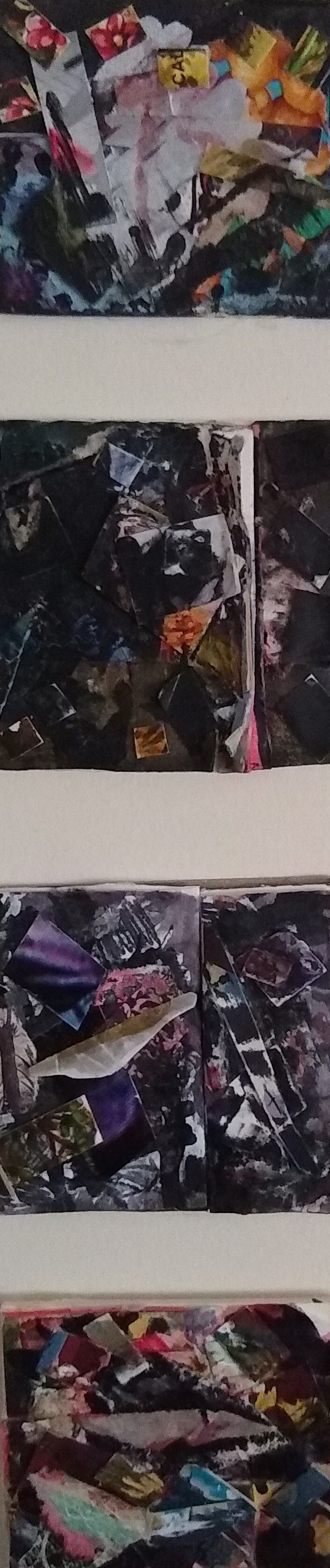
Small works can be perfect, but perfection itself is not small. There is nothing insignificant about small works that have the spirit of detail, reference, and metaphor. Seeds for conclusions can be drawn from them and the advantage to which they can be put to use in larger works. Like a drop of water helps to swell the ocean, an artist understands greatness consists in being great in little things.
There is a kind of omniscience in small works, in every particle that makes up its existence, that suggests a more significant and sustainable effort. Little by little, collected together, small works become a great deal. Like the creation of a thousand forests from one acorn. Nothing is too little that relates to our salvation.
The critical acts executed in the studio become the starting points of creative work. Magnificent results turn on the hinges of little things, minute events. We often fail to see in large imposing work the possibility of things coming. In working the “small” we are free to use or abuse our needy ambitions. Small pieces do not suffer from the psyche. They seem to console, kindle worlds, preserve and pressure hearts. They show themselves as they wish to be seen. As they are. Floating signifiers applied at will to different strategies and situations in the studio.
But how small? And in comparison to what? Determining the smallness of the work is an intimate decision. It is a contraction of thought and action rather than an expansion of bravura and scale. When we speak of “small” are we speaking about little, diminutive, wee, tiny, teeny, minute, or miniature? All coming into comparison conspicuously below the average in magnitude, especially physical magnitude. Small as opposed to large and little as opposed to big or great are often used without distinction. But small, more frequently than little, applies to things determined by number, size, capacity, value, significance. Small is also preferred when words like quantity, amount, size, and capacity are qualified. But what of the intangible and immeasurable? Can “small” move beyond the boundaries of measurement? Switching “small” for “diminutive” or other words like “miniature” has the implication of divergence from larger works in physical downsizing as well as falsely promotes the idea that the “small” cannot be large in ideas, a carrier and embodiment of an open-ended metaphysic.
“Small” refers to a perspective that values and explores the significance of scale in regard to the understanding of larger works. But it also challenges the tendency to focus solely on the “big” and “all- encompassing”, suggesting that profound insights can also be found in palm-of-the-hand paintings. Gottfried Wilhem Leibniz (d. 1716), German polymath, wrote of “small perceptions” that contribute to our larger ones. Understanding how work is structured, changes, and is noticed regardless of size is essential for understanding the experience of painting. The idea of collective small actions can have a wide-reaching impact. For example, small work can lead to more focused, less cluttered compositions. Not to mention the virtues associated with smallness such as simplicity and humility, innocence and wonder. In Blake’s Auguries of Innocence, written around 1803 but not published until1863, he writes seeing a “world in a grain of sand” suggesting profound, even infinite, truths and connections can be found in the smallest of things rather than in grand gesturing or displays of virtuoso power. Smallness implying that the insignificant holds within it the potential to reveal the vastness and complexity of the universe within human experience. A childlike wonder of the deeper truths hidden within simple things.
More than “eye dust” a small work is made with passion and a design-conscious impulse like any large composition. A painting in its own right, the little vignette stakes claim for a fullness of presence, an intimation of transcendence. A scale of metaphor that sparks its own profound narrative. A gravitational snap rather than the crunch of a larger work. The paddock for our grazing and playing. A change in cosmic time because it is never haloed with permanency.
It is the boiled down juice of our work. A small composition that allows us to focus on a single moment taking in its totality. Capture, in essence, a selfless spontaneity. There is an emphasis on suggestion and inference. Instead of explication it relies on evocation, bringing the viewer into the work to complete and judge it, to foster a deep connection. Brevity and scale are juxtaposed for impact allowing immediate thought-provoking responses. Hermetic and profound in a concrete manner that engages the viewer’s imagination and personal experience without standing at a distance. A shared intimacy with the artist, vivid and focused, yet something secretive, not fully disclosed.
These works of “condensery” cull everything toward its essential shape. Less time for beginnings, middles, and ends. Less space for rising notions and denouements. Here are hard-won emotions in a highly compressed space. Airy and graceful as a Vivaldo pastorale, refreshingly simple and accessible to the imagination. Yet in another way, from the backdoor, so to speak, a tiny picture in one’s psyche. Minimal but not necessarily minimalist, the visual coming into consciousness evokes a greater creative process because the shift is from ideology to the attention of play. An act that may help lead the artist back to first principles.
Miniature denotes smaller than normal, a replica or model. However, it has taken on its own peculiar art form. The word has its origins in the Latin miniare, “rubricate” and “illuminate” , from minium, “red lead” or “vermillion” (used to mark words in manuscripts). Its Latin ancestors were concerned not with size but with color. Early on its association with drawings miniarewas broadened to mean “to decorate a manuscript”. The art of illumination or miniaturacomes down into English in the sixteenth century as “miniature”. But miniatures have a very long record dating back to prehistory.
Small works can be said to be “minimalist”. But minimalist works are not necessarily small, when one thinks of Ad Reinhardt, Agnes Martin, Donald Judd, Ellsworth Kelly, Carl Andre, Sol LeWitt, Anne Truitt, Robert Ryman and others. The abstract art movement with European roots in Bauhaus, Malevich, Mondrian, De Stijl and Russian Constructivism that emerged in the US in the 1950s and flourished in the 1960s and 70s characterized by simple shapes, hard edges, and a focus on the essence of materials and forms.
A personal interjection. Moving to Tucson many years ago to begin a new job, it took a while before setting up a new studio. Creative juices never ceased to flow, however. Finding time for studio work was always a challenge. I took to making small paintings and collage from business cards, using office supplies (markers, ink, stamps, white-out, tape, etc.) I had in the desk drawer along with a trove of trash found walking around campus. I called these small pieces “microworks”. On the average they were 13/4” X 31/4”, no larger than 5”X 5”. I made them during my lunch hour at my desk, quickly, and placed them around the office. When students, professors, or other artists came to see me for one reason or another, they left with one or two of these works. My first solo exhibition in Tucson was of microworks. Beside extreme aesthetic delight, the experiment with structure, scale, and exaggerated expression predicted my returning later to large canvases (72” X 72”, 84” X 84” ). A resulting foresight toward a more experimental deeply rooted imagery. The small works, in a word, were clairvoyant. The “maximal miniaturism” that justifies W.G. Sebald’s epithet for the micrographic works of Swiss writer Robert Walser (d.1956) as “clairvoyant of the small”.
As a fine-grain visual perception clairvoyance of the small is the psychic ability to see beyond the normal range of sight. As a way of predicting the future, not in the literal sense, but in its ability to perceive and express realities beyond the ordinary, it is a way to create work that envisions new possibilities. Techniques like automatism or free association can access the subconscious allowing for the emergence of unexpected imagery. In Magritte’s self-portrait “La Clairvoyance” (1936; 211/4” x 25 9/16” by no means small) the artist is painting a bird in flight. But instead of looking at the bird, Magritte is gazing at an egg. This juxtaposition of egg and bird along with the title suggests the artist’s belief in the ability to see beyond the immediate, envisioning future prospects. It is an example where the artist portrays the act of painting as both object and mediumship.
As an extra-aesthetic discernment, clairvoyance allows access to seeing visual information not readily available through ordinary discrimination. Like a white flash that slithers through leaden clouds it invokesprecognition (seeing the future work) or remote viewing (seeing past work in the present). Regardless of past or future, it involves seeing images and impressions not always literal but intuitively (or as metaphors). “Clear seeing” (Fr. clair+ voir) uses the sixth chakra energy center in the mid-brain behind the forehead. The “divine eye” (Pali, dibba chakra) one of the sixth faculties of higher, fire-bright knowing. The “what-it-was-to-be” or clean-washed essence of a thing (Gk., einai). The cryptic morphosis that is the seeing of latent shapes or obscure forms (Heraclitus, frag.54).
Imagination is a clairvoyant function. Making small abstract art is a way of seeing outside the normal range of studio activities. One might say it is a scrying or clairsentience (“clear feeling”) that involves a physical sensation of the object literally in-hand. A psychic perspective or dimension of vision that is an evanescence on the periphery of vision. The “eyeblink” (Augenblick) that is instantaneous as lightning.
The question may arise, “Why do small work?” One important reason, it is affordable, cost effective. It has built-in space-saving nature being small and easily storable. Most importantly, it easily encourages experimentation and practice. As a unique way of viewing the work through close engagement, it displays versatility. In this manner, the focus is on the overall “look” and details. Imagining how such small work would look if it was greatly enlarged would be seeing it through the reverse lens of a telescope.
Of course, transporting the work is easy. Simply put them in a box or pocket. Materials can be found everywhere and generally are less intimidating. Breaking through procrastination, taking more risks, experimenting faster, the work becomes more personal, the more singular an experience.
Making small works takes pleasure in recontextualization: in defamiliarization, in dislocating habitual, conventionalized perceptions and refamiliarization, in recasting established optics into material culture. The cohabitation of contrasting forms in which one image is superimposed on or equated with another provides new eyes in which to see. Using “double vision” as an ironic distance small paintings and kindred standbys transform both topic and imagery.
In a perspective of incongruity, the small painting, drawing, or collage goes against any specific horizon of expectation. Implications are open-ended and unfinalized, waiting to be augmented, altered by artist and viewer. For the artist, whenever the work begins to stagnate, working small is a source of inspiration, a model to be emulated. Turning away from established visual associations and conventions, if acutely observed, the visual language of the small never becomes monolithic, neutral, and closed but pluralistic, varied, and open. In this corner of the universe, an initial innocence must be recreated, a return to a naïve state where the small work reveals itself and imparts its first welcome. A “divine favor” as a visual awareness that transfigures art practice, offering new life to a greatly expanded two-sided act: equally for those who made it and to those for whom it is meant.
Comments