August 2023 Blog Was Laozi a Painter
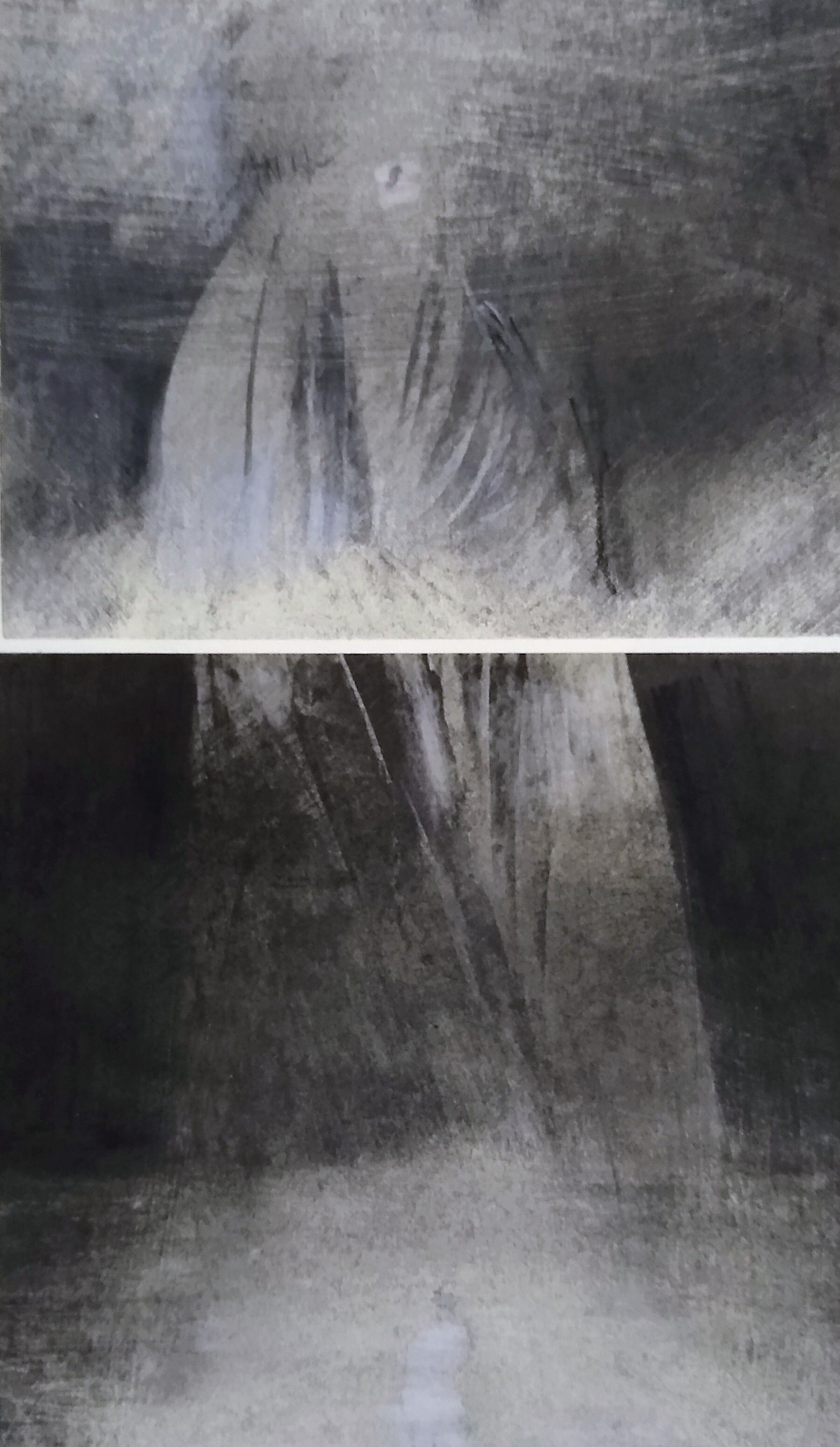
Was Laozi a Painter?
Five Fragments for a Future Scroll
In the sixth century BCE China there was a person called Li Er, Li Boyang, Li Dan (hor Lao Dan), respectfully known to us as Laozi (Lao Tzu), the “Old Master” of Philosophical Daoism.
He was Keeper of the Royal Archives of the Zhou dynasty, where all the wisdom teachings of the great sages of the past were collected and preserved. Shaking his head at the ignorance, unscrupulous behavior, self-interest, and moralizing of the world around him, he abruptly left the position. It was the first time he self-exiled.
In what seems like a once-upon-a-time story, Laozi mounted his water buffalo and rode to the Western Pass to “get out of town”. At the frontier boundary, he was recognized by the border guard Guanyin who begged him to leave some final words of wisdom.
He dashed of fragments he was working on roughly written number of fragments he was working on, though inchoate and roughly written, about the Painter’s Path and the virtuous dark treasury Way (Dao) of painting. (It was the second time Laozi called it quits he left Guanyin with the Daodejing, never to be seen again.)
Five Fragments for a Future Scroll is part of a root text that you will soon read. Hailed by scholars as one of the most ambitious cultural documents in art criticism, it engages painters in seeking sudden juxtapositions of apparent irrelevancies that change the nature and composition of painting. It skips and jumps around, makes connections, and uses unexpected reversals. It resists definiteness and follows a course coherence he dubbed Process. A watercourse way where the plumb line’s echo gives hope at the expense of assertive rationality and lifeless instruction.
Process is the empirical way of working the Universe through painting. It is the origin-moment, the ten thousand things (wanwu) in transformation. Matter and energy as a single breath. Source of appearance, Mother of the Cosmos whose designs wander among the oldest layers of our far-off visions. Sage radiance of inner and outer, alive and in motion, turning towards the primal and uncertain, it opens the ever-changing realms of nondual Absence (In-Folding/Nonappearance) and Presence (Out-folding/Appearance). It is a self-so (ziran) way of painting heaven’s curve with ontological and cosmological depth. In a dimension all-encompassing, it is no less than the generative transformative respiration of fullness and emptiness contracting. Occurrence appearing of itself, painting swiftly becomes the snap of Mindsight.
To get from one place to another physically, psychologically, and beyond the silk of dreams, Laozi gives you a nonpurposive way of painting essential to your nature. A Painter’s Path of virtuosity, the power of premonition and initiation. The twilight of a new divination unfolding like the sudden turning of birds in the sky. You rotate and disperse all things converging in unicity around a moving empty center. Your awakened painting pivots through this ironic repurposing recontextualized. Riding the surge of circumstantial painting, all things get their birth and have their life. Never directly demonstrated it is prior to the packaged reality of thought. Using no-knowing to know, it is the Painter’s Path beyond self. Embryonic origins known only through awakened, immediate experience. This is the Dao of non-action (wuwei), the hinge of nothing’s own doing. Painting before it is named “painting.” It is called Dark-Enigma Painting.
Here then, are five pericopes of Laozi I randomly selected and translated at great expense one fetid Hong Kong summer night in 1974 that left me with the desire for cold water on my neck and face.
Five Fragments for a Future Scroll: Selections
Any path in painting can be taken
If it is the correct path
But no path can always be the same
Any name given to it
As dogged by thought
Can never determine its essence
Let it be nameless, undetermined
The blossoming of the ten thousand things
Just so.
Desireless view the mystery
Each work calls for
From the path of what is
Named by the self it leans on the walls of boredom
Blind to the wonder of Oneness of Dark-Enigma Painting
Dark-Enigma Painting remains within Dark-Enigma Painting
The Great Image Without Form.
Comment:
In naked solitude is the wonder of the Nameless in Dark Enigma Painting! Laozi’s Dark Enigma Learning (xuanxue = xuan/”profound”; xue/”learning”) is the Way of Mysterious Learning Painting. The ancient glyph denotes a shade of black with dark red hidden from view, or the image of two silk cocoons suspended over a vat of purple-black dye. A metaphor for a profound truth that escapes ordinary understanding. Without deliberate intention or purpose, possibilities and permutations open to the un-wanting who see what is hidden. Those ever- wanting see only what they desire. Value the root and extinguish the branches.
Here is a view to the Painter’s Path. Without a backward thought what you put down with brush and paint is what the work tends toward. Its contours and boundaries, its resolutions and outermost manifestations, substantiate the fertile and nourishing Cosmic heritage. It is the Way before it is named. Before things give birth to one another. The Dark Mother of Creation, generative cosmological sap and substance that awakens consciousness and shares its wellspring.
When the world tells you what art is
There is no art
When all know the good in painting
There’s already bad painting
Just be present to Process
Good and bad will collapse each other
Abide in Dark-Enigma Painting
Everything will arise on its own
Never claim credit
Never dwell on finished works
Comment:
Ideals and goals threaten the hiss of Creation. Objects of deliberate pursuit have attachments that go with it: fakery, inauthenticity, artificial effort, conformity, influence of style thereby undermining Dark-Enigma Painting that sets in position nonpurposive spontaneity (ziran). Don’t dwell on your achievements. Embody the generative power of nondoing (wuwei). In this “self-so” does something appear. Occurrence appearing of itself is your Teacher.
Process is a gushing forth
Disarray and an emptying out
Abyss-deep it is your Source
Untying you to see
A semblance of Presence
Of what precedes the highest heavens
Comment:
Initially chaotic and messy your work is an accozzaglia (Ital. “jumble”) of conflicting elements. The Process of Absence and Presence is a single breath-force that begins a blending or intermixture, a scrambling and susceptible fashioning of things – forms, shapes, colors. Through aesthetic subtraction, a flushing out of extraneous matter occurs. In a field of emptiness all things begin to merge yet remain aloof. Now the choice is yours: the abyss of the well or the abyss of the stars.
Empty but never exhausted
With each movement of the brush
The concealed is presently disclosed
Where instructions are many
Blind alleys multiply
Maintain instead absence within
Comment:
Empty of preference you welcome the just-so. Spontaneously, fluidly, doing without doing. Take yourself away from among the mirrors. Join yourself in a new season of incandescence. Wonder confronts certainty. Understanding spurts from your brush like a hurricane of black pigeons.
Seeing into your work
There is nothing to find
Unnamed
A swirl and a liquid
No-thing
Vague and indistinct
From front
To back
Enter into the Inconceivable
Steer the Present Course
Comment:
The work is looked at but never seen. Invisible yet braided together with infinite margins beyond words. You hold tightly to what you know and so it is imperceptible. You miss that which is concealed in formless form, in nothing’s image. Do you even know how to be muddy, so muddy that through stillness all slowly becomes clear? It is the origin-place born where empty realities fail to reach.
Dark Enigma Painting is Absence-Presence awakening without the anchor-identity of the self. It undoes the distance between primal appearance and image-making. Before all assumptions and intentions, it unfurls through a diverse array of myriad happenings. With empty-mirror perception you wander pure and simple along the Painter’s Path. You trust yourself in what is beyond you. Your painting shapes itself, emerges in the way the seasons emerge. Range free, it becomes the hinge of Dao, selfless and spontaneous, idle and effortless. The first touches of brush on canvas are the origin-moments where the ten thousand heads of Presence emerge instantly from the trunkless tree of root-sharing Absence.
Comments