All-Imagining - The Afterlives of Paintings
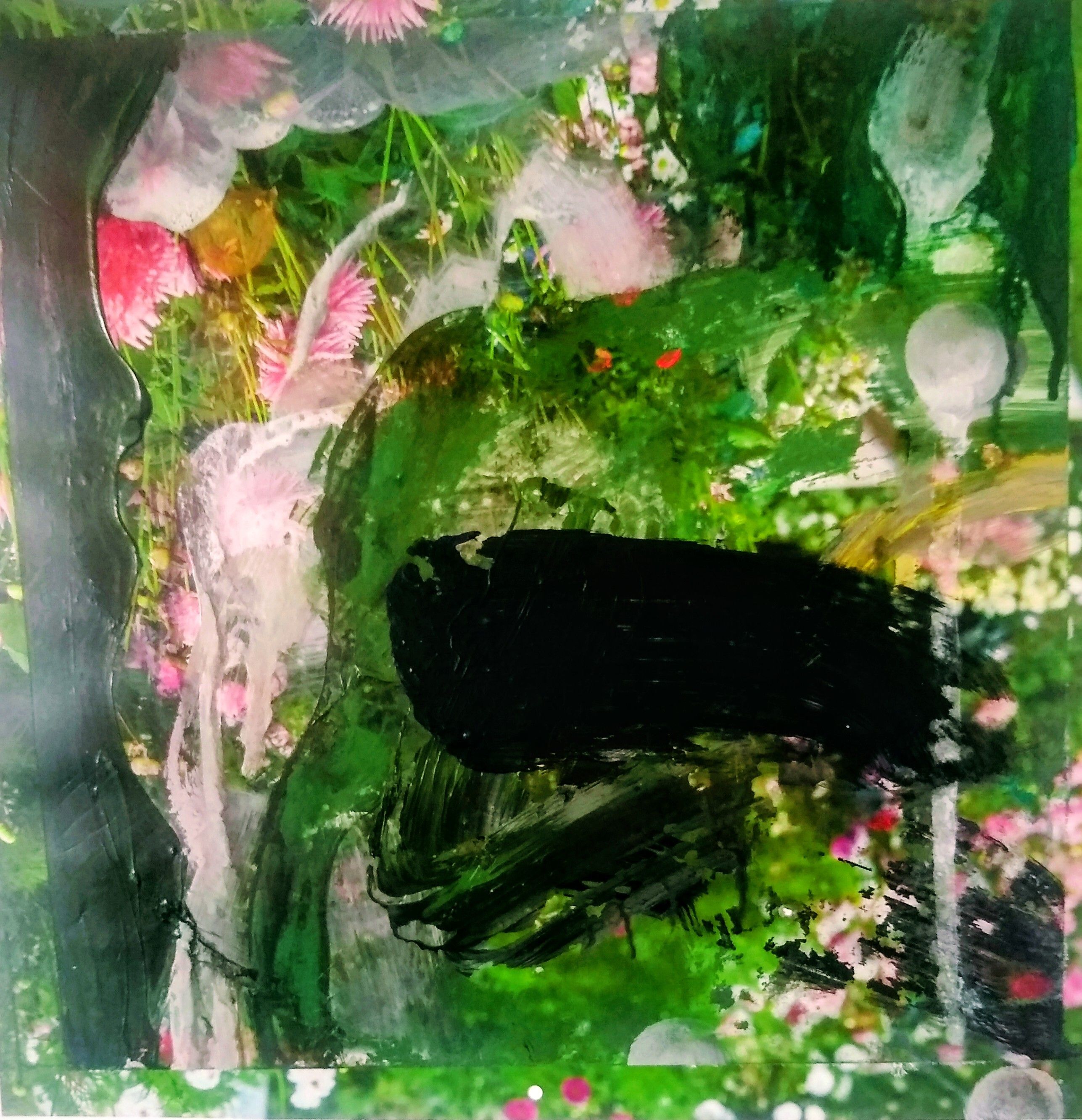
The best way to study painting is with eyes shut.
The “afterlife” existence and identity postulated of an individual’s consciousness that exists after death is not what this essay is about. Not the continued existence that may take place in a spiritual realm or the rebirth into the world to begin the life cycle over again.
The afterlivesI am addressing is the all-imagining pluriverse. The epiphanic, diverse, and self-disclosing characteristics that can appear in paintings. The multiplicity of prophetic revelations rooted in the nature of the mind as in the cosmos. Under the shuddering eyelid dreams that gnaw the nerve strings the shut eye sees. The down dimensions floating below sunlight. The deepest delights of the dreamer.
We use thought to step through the stillness as a response to the past and the projection into the future. Responses that are encoded, stored, and retrieved. They are limited and change when recalled because of the psychological relationship between perception, contact, sensation and desire that arise through identification with the fictional self. Like time and space these are the creations of the mind, a distortion of a living ancient heritage covered over by millennia of conditioning. Out of limitless desires parochial myths of success, failure, and general negative self-criticism have interfered with the enormous embrace of our potential awakening.
Art depends on ambiguity, polyvalence, resonance, obfuscation, and illumination. In short, the transcending of that which, according to an ineluctable law, has necessarily to be the case. It deploys the deconstruction of outward appearance as a means of countering self-obliteration for pure execution rather than notional panic. Where aligned along its imaginary axis the imaginal sings its ephemeral miracles like the blind man who edges along the bridge.
The practice of focusing on the methods used to understand meanings and experiences, obvious and concealed in painting, encompasses a broader nature. Its context, visual language, and the interplay between the painter and what is being painted can uncover intended or unintended meanings. Understanding its parts and understanding the whole creates a continuous cycle of interpretation. This can be done simply by making observations and drawing applications as nonverbal communication around which far-off stellar hours move near, and constellations are clearly discerned.
But we are taught to look at art in a very traditional way. Insistent that the work of art examined and interpreted is through a structured process involving formal iconographic analysis and contextualization. Methods that focus on symbolic content, and historical circumstances surrounding its creation.
The formal analysis that is the visual and material aspects of the artwork – color, line, shape, composition, and so on. The systematic analysis that typically involves a descriptionand how the overall effect is created. Iconographic analysis to the contrary is the studying of symbols, themes, and subject matter in order to disclose intrinsic meaning, and an understanding of cultural and historical conventions. Contextualization views the work as an artifactwithin its historical context. This involves considering the forces that influenced the creation of artwork. For example, historical period, artistic movement (style), patronage, and biography. These are the orthodox approaches of the immovable upright.
However, the afterlife of a work of art is what reminds us of the direct way in which the imagination animates us to seek a greater vision like the wide sky above the faded forest. Not as concerned with the outer dimension, it shows us the searching corners of our mind inspiring remembrance and contemplation of who we are. As support to the spiritual life the internal knowledge that can crystallize innermost realities in form, space, and time. A unity upon the plane of multiplicity, making archetypes perceivable by the senses. This is the undergird for the metaphysical framework of lifelong inspiration and sacrosanct knowledge. From physical senses to revelation beyond the conventional systems that touch our hearts and turn chance impulses to radical astonishment.
Works of art are much more than their aesthetic value. They constitute living forces, almost living entities, embodying power which as suggestive and creative effects penetrates the mental room and opaque windows of mind discharging the thought that we are capable of anything. A quality that opens up questions about methods and interpretations that are genuinely useful to investigate. Theoretical and practical in that it relies upon hypotheses and actions. Actions that are the consequences of hypotheses. Theory, from the Latin theoria, referring to contemplation or speculation, thus foregrounding a connection between artist and resulting work. Seeing what was overlooked, “observing” instead of simply ”noticing”. Best characterized by C.S. Pierce (1839-1914), American pragmatist philosopher’s term “abduction”. A matter of forming creative hypotheses, drawing links between images, events, or pointing to show such links embody something like a rule. An abduction that involves “reasoning backwards”, supposition, and insightful guesswork. How conjecture, that is, the act of theorizing, hypothesizing or inhabiting a world “as if” functions when looking at an artwork. That each work is ripe for philosophical speculation and analyses, the magic of mind. As speech clings to the mouth in the way that dilettantish artists love art for its own sake. In the country of metamorphoses, the paint brush is the tongue of the hand charged to a deeper meaning beneath the surface.
Using the method of unlocking consciousness by focusing on apparently insignificant elements such as dream-like images, color choice, unmediated shapes and forms. “Symptoms” for Freud, or “clues”, features that highlight another seeing that is a striking paradigm shift away from conventional reading. A sort of ancestral form of conjectural logic that involves artistry, imagination, and speculation.
We move the mystery to a somewhat solution. The powerful, if not libidinal, force that can supersede the spell of rational explanation. Not simply to access the truth covered over by the aesthetic lure but to grasp the reason for the peculiar lure itself. Never losing sight of how the work is structured, painted, “narrated” or “oriented’, raises questions relevant to the artist why one reworks or interprets it. Although devices of analyses can slow down or retard both overall and detailed “actions”, it may provide autobiographical information vis-à-vis enigmatic painterly expressions. The depths turned round towards us.
Is not the position of the spiritual hermeneut…similar to that of the artist?
- Henry Corbin
Hermeneutics is the study of interpretation. It focuses on the methods and principles used to understand the meaning of texts, especially religious texts as well as literature, historical documents, events, experiences, and human actions. It is the art of how we derivemeaning. It begins with orientation (the relative position) followed by questions of interpretation (Ger. Verstehen, “to understand”, “know”). Simplifying the action, we look at a work of art as having three realities (or modalities, states, stations, levels), bound in and embracing (1) the outward reality, (2) the inward reality, and (3) the hidden reality.
THE OUTWARD REALITY
What is the cause of the work’s appearance? In pale judgment is it coming to be, the dispositions of its existent things? The way the paint is applied, the arrangement into component forms and shapes, the space, light and dark. How can they be identified? These are the “rational” beginning investigations.
Beyond characteristic traits, that is, the goal of seeing and identifying, understanding of the work is paramount. But one-dimensional understanding is the first level or stage that demands discernment of things in their proper place.
The components that appear on the surface for us to find and perhaps contemplate. The first step of the journey, so to speak. It is the painting that represents the painter, represents us in a still inchoate form. Studying the outward reality of the painting is the discipline of art history and aesthetics. The particular mode in which something (the painting) exists, is experienced or expressed. Methodological approaches that are employed by specialists to study works of art make important contributions to our understanding of its nature, but most are firmly rooted in a restricted, if not, underdeveloped visual experience. They often assume the superiority or ultimacy of their task to education and devalue other interpretations. In general, modern scholars don’t presuppose an ultimate reality or source that unifies all of existence and the natural world which includes the making of art. They don’t know the subtlety of their interpretative techniques or their evaluation of multiple meanings, the grand diversity in spite of many points of commonality. What is left is the coddled loyalty of an old habit.
In a periscopic sort of way, we begin to see if it doesn’t conform to previous patterns we slow or shut down. We release ourselves from the passage of time, until something new or different appears; a virtual presence or a certain intensity otherwise impossible to achieve. As we stop and start with the erratic spasms of process, we may seek proof of our passages, the ghostly twin of ourselves, the shape of consciousness, effluvia of inner life. Reconstructing the continuance, the fragile nostalgic equilibrium of something. Sparked in the excitement of enrichment, the elusive becomes concrete. Dispersed in a fertile surface that recovers, devours, displaces the past. Digested and remade, a casual incident or “accident” becomes a grand reflection. And since in theory things outlast us, works of art knows more about us than we do about it; it bears its experience of us within it and is – in a literal sense – our history open before us. It looks across at us, unblinking, and fixes us in its gaze. But how little at home we are in its interpreted world.
THE INWARD REALITY
To embrace the multiplicity of meanings, we need a shift in perspective. From formalism, style, iconography, contextual approaches, biography and autobiography, psychology and aesthetics to the subjective experience that connects us to our innenleben. An “inner life” characterized by the poet Rilke (d.1926) as a rich spiritual and philosophical landscape, a “cosmic inner space”. However, we must stand “within it”. Allow the heart or soul to express itself, to hear the deeper callings that may come as a whisper, shout, or scream.
We define ourselves against the past that may provide l’effet du reel at best or simply somnambulate from one center of attention to another “hallucinating” the connection between parts. A gradual opening out, in order to find an unfolding of new structures or old ones in a new light. Circling in the presence of the work as an invisible referent. Obliquely, tangential, by direct confrontation or aslant. Approaching us as we view phenomenologically, incisively, to ascertain if all things indeed belong together. In a completely unplottable manner, we find what we are looking for. However, if we look for things that we have looked for before, they might connect. But connect only in an obvious way which isn’t very creative. To do something we haven’t done before we need a healthy dose of curiosity that will move us from one astonishing thing to another. A personal ideology that has become universal. Not just ours. For that is an idiolect. It is following our own journey with the weight of human history, back to individual human life. It is going beyond us and finding the return.
We resist the departmentalizing of seeing for a greater perception and experience. Focus attention upon sensory imaginative immediacy and thereafter ruminate about the implications, what Gaston Bachelard called “reveries”, and what literary analysts referred to as “epiphanies”. With wide implications, intensity, and sudden arousal as a wedge in time they fertilize us in their unpredictability. The method of “epiphanology” (Bidley) or “visionary recital” (Corbin) that illuminates moments of revelation. Patterns of single element or in combination, forms or groups, serve our orientation, no matter how fragmented or “knotted”.
There is a thread spirit to our movement of going inward that includes the spinning and weaving new actions to be taken in our work that display an interconnectedness of all things. But where our work is held together by a spiritual thread, it can also become “knotted”. Knots that we create from worn-out beliefs and practices, concepts and mental constraints that delimit, or negatively “tie-down” the absolute and non-limited reality. Knots that prevent us from perceiving what truly is. Knots of the false self that bind the mind around a specific concept of what the work shouldbe. Any attempt to define the Absolute or Source of our work in a fixed way creates a knot, a biased, limited perspective.
Looking positively upon knots rather than negatively (“not”) as entanglements, complications, doubts, and difficulties, vines that ensnare us and keep us impeded can be expedient devices. Much like Zen koans that bring us toward a more enlightened approach and authority to our practice. This means moving beyond attachment to any single work or direction, process or concept. Artists and viewers alike can recognize the true reality of diverse manifestations without being constrained or being habituated by any single one. Let us not forget that knots are a symbol of eternity, unity, protection and connection, wisdom and compassion, unbreakable bonds, and longevity to mention a few.
A knot has the notion of questioning built into it. A feature of all sacred knowledge. It is universal and part of the finite and situated character of all human knowing. Questions of interpretations that induce awakening or test our understanding. Inquiry emerging from the work for the rigors of examining and refining. Moving from one’s reason to an “ontological event” it is an interaction and analysis of process and its conditions of possibility, where even the unproblematic understanding and communication cannot be assumed. Questions of each part of the composition dependent on the questions of the whole. For example, specify a set of images or symbols and a set of ways to formalize them with questions. Assign meanings and qualifiers. Connect to what is seen in the work to build a domain of discourse, to characterize the images and symbols expressed. “Translate” the images and symbols as many ways as possible. Move from “it is possible that” to “it is necessary that”.
As we enlarge on the brevity of any sudden, intense arousal, and on any unpredictable revelatory visual understanding, the resultant exemplary vision serves us as the orienting paradigm. More attenuated or fragmented instances could then be mediated upon relating to the paradigm to disclose what is overlooked, denied, unthought of, in the imaginal moment.
We proceed to examine this closely and note from time to time their inter-implications. The components will prove to be psychologically and spiritually interrelated in valuably useful ways. As an expression for our state in time, it summons us to realize what lies within us. Our “vocation”, in what we hallow and what is guiding our direction, giving it an embodied reality. A change in the sense of meaning that will affect the circuits of the brain, challenging us to explore new avenues for fostering transformation. Our thinking will swell.
THE HIDDEN REALITY
In the metaphysics of imagination this is the undisclosed dimension where silent infinities and the amplification of archetypes potentially proliferate. It can be a personal archetype or any powerful form revealed. The task is to “unveil” these cosmic and meta-cosmic prototypes and epitomes of imagination as they occur . It is an infinite network or streams of interlocking images. The abode of the active imagination and the repose of the spirit. It is also the cognitive function of the active imagination to act as the organ of perception for this reality or station. When nothing happens engage in lyrical abstraction. Lyrical abstraction is a fitting expression of images that resonate. Images that “speak” in metaphors that are open and compelling as an echo. “Tremors” of a personal cosmology. Frameworks to reorient and provide another way of speaking closer to the phenomena as they appear.
*We dream the image forward.*A shift occurs when we stop thinking in terms of imperatives and adapt ourselves to the living process of creating. The whole enchilada that our souls carry. The sense that a work of art is a living thing. That all we have is a working hypothesis that revitalizes existence. A shift in two directions: what has preceded and what will become. A “working space” suspended between a larger continuity. The legacy as far as what one leaves to others.
We summon our longing. We group the varied disclosures regarding process, imagery, ways of seeing and interpreting, all the variants of paradigmatic signs which is at the same time the primal Creation. In our thoughtful fantasies we awaken the epiphanic imagination, the reflective illumination which makes vision possible. With swift allure leading us smitten by our discovery of what we might be. We change the day and gleam with genesis.
The rich imaginings of our hearts are the begging doves of divine intimations. Imagination the greatest of all intermediate realities is the entire cosmos. Degrees of human attention, human imaginers-receivers of varying states of awareness find their true prophet in speculative intellect, experiential perceptions, and the spiritual tasting of aesthetic grace. Yet there is much more than aesthetic value in our work. Our work constitutes living forces, almost living entities, embodying a power which has suggestive and imaginative effects.
Initiated Symbol Projection (or Symbolic Free Association), a psycho-diagnostic and psychotherapeutic technique developed in Germany since 1948 is a series of guided images or symbol-based scenarios to access and explore the unconscious. Allowing the unconscious to flow spontaneously through images that serve as direct voice of the unconscious to reveal deeper meanings. It is believed images bypass the ego and its defenses, giving way to freer expression through a process that is both active and spontaneous without conscious direct control.
All works have multiple meanings that can be interpreted in more than one way. But we are asked to accept the fact the work has only meant one thing. Our work will most certainly find a way of eluding the clutches of those who fix the universe into a single shape. For us, raising philosophical and metaphysical questions about knowing and being as well as how the work can be told is seductive. It tells us something that we have always been close to knowing.
We must look at our work with transcendent hearts. The metaphorical organ of nonrational perception. The heart that leads the mind to rise above the thinghood of things. The interior “vertical” dimension that recognizes the afterlives of a painting. Absolute values that can be perceived as the grammar of the cosmos. We lose our unawaken self to discover our authenticity, the awakened imagination. Only to remember that each of us has been correct at his or her own level and has made no error.
In this laborious nowhere there is invisibility and intangibility moving us. Where the plates still topple from the sticks that twirl. Where the complex equation equals zero and mystery is more like a shadow than an isolated light. Where roots of our thoughts and feelings grow and live with the overall composition until it is unable to sustain any more weight. Where we see only the reflection of the Open. At last, a final shrug of contradiction breaks the surface between what is and what can be. The nervature of past and future life now serves as road markers or travel posters for the territory of everything trivial and vast. Every nonstarter, potential image, feeling, or idea. A plethora of imaginal worlds that is the metaphysical underside of reality.
Having embarked on a game of chance, we rolled away from a nocturnal vanishing point. Eyes no longer trapped at the portals of freedom. As a gust in the god that can see right through us, we reconsidered the grasp of our work the way brooks and running springs move.
We now seek afterlife moments that turn in our work.
To feel the breath, they bear.
Comments