A Restless Openwork
- Thoughts that slip like fish from the hands of a blind person.
Creation is born out of restlessness.
In so many universes saving us and wanting to smile.
In the mansions of essence.
In order to make room for discovery.
A strange drunkenness like scattered sunlight that fully opens us to surrender.
A hypokeimenon: something that is always there, underlying and essential, remaining.
Into a great landscape that is the ecstasy of emptiness.
Pressing in with sharp urgency like a red flame.
Sensitive, fully alive, completely without hindrance.
Without border, without center.
A revelation not to be defined, that brings obscure doubt and exquisite order, never oversensitive to form, never self-conscious.
Memories that take motion like children dancing in a ring.
Like snow exposed to the sun. Melting until it disappears.
Look at what we do.
For that is what we are worth.
Joy juice shifting, not nail hung.
We yield to the open restlessness that knows no knowing.
Knows no space no time only the wonder of creation.
The many worlds before this one and after.
What is done for us, we allow it to be done.
Each molecule, atom, has creative needs and possibilities.
What we must do for ourselves, we just do it.
We seethe with potential. We yearn throughout eternity for perfection.
We are placed in a substance, seeking, to lay claim – to what?
To exist as symbols open to our own restive understanding.
An existence that has more than one meaning.
More than one body.
Continual change is our very essence. The intention clear.
Stuff ourselves with sonorous images.
Drown in the creation of our work.
The drowned are not troubled by rain.
- Here is an unspeakable secret: paradise is all around us and we do not understand.
-Thomas Merton, *Conjectures of a Guilty Bystander,*1965
Every part of the creative process is without end. Since we ourselves are part of this active eternity, we can always discover what is painted towards our name as well as away from it. In this manner, internalized and eternalized are juxtaposed, balanced.
The interrelatedness of all things take shape in the emerging image. Body and soul, mind and matter, present and past belong to one continuum. Coincidence by secret design joins irrationality of process to form a new “logic”. The strange threads of perception and memory give rise to the uncanny. Neither particles nor waves but as having the properties of both. Observing the image in process alters the image observed.
Restless openness requires interpretation. Metaphorized, “carrying it over” to our unconscious, human qualities are conveyed directly so that they act on us. And we respond to it as in a human encounter. Helping us understand what we are doing rather than ingesting information. Being acquainted is the first step of an ongoing relationship. Yet never fully known since it remains ever-changing, evolving, revealing further aspects of itself. It is always fresh, though familiar, in the original sense of coming to belong. Images with which we stand are in close relation as with familia.
In the Jungian world our cognition is wired to re/cognition. We begin to decipher the image by recognizing something we already knew. It has become clear where before it was latent, intuitive. Nietzsche writes: “It is through knowing that we come to have the feeling that we already know something; thus, it means that combating a feeling of newness and transforming the apparently new into something old.”
Knowing not learning. Untutored facility, gifted skill, both in the sense that it come unasked. An edgy straightforwardness not the product of the effortful learning of rules. An intuition suggesting an origin outside the left hemisphere of the brain.
- When flames of fire rise from the corner of your vision.
The view of the artist’s creation is a discovery rather than an invention. Learned techniques and color instruction take you so far. Art is a spiritual revelation, intersubjectivity and annunciation.
Hegel: art is the sensuous display of the absolute. What makes something an “artwork” is its non-contingent capacity to convey content to our minds and spirit. Heidegger takes aim at this approach by observing that the artist is an artist because of the work just as much as the work is a work because of the artist. “The origin of the artwork and the artist is art”. A work of art brings out in its own way the presence of things, its truth of Being. That Being places itself into the work.
Inexhaustible fullness
Proclaiming itself
Fugitive particles of time
Expanding contracting
Like an accordion.
- A rhizomatic space in the minor marshes of time.
The question finally arises: What is it to be “open”? The state of mind that understands, “I am open”. To understand, there must be attention. No sense of comparison or condemnation, no waiting for further development. In this ever-widening space there is an openness beyond limits, a restless “otherness” that rebounds into mind, shuffling consciousness from absence to presence, from presence to absence, over and over again. A serial attachment and detachment, to and from the eternal sphere. A non-objectifying approach in a continuum of appearance as a condition of embodiment. Carrying openness within the body cases we bear. A condition of existence, the anima of subtle seeing where we are able to tap into one’s own being.
Openness also suggests “non finito”, a refusal to reach any conclusion. Bearing afar initiative and premonition, it hovers in a perpetual state of flux and receptiveness close to our frontiers. It can be taken as whole entirely. At the same time, each of its parts reveals its totality, like every coded cell of an organism.
An openness that is a “thereness” and an intense concentrated presence. A force field that fuels meaning, metaphor, and imagination. As de Kooning stated: “Even abstract shapes must have a likeness”. There is an interplay of “reality” and “turning” (trope). Bringing into the present and pursuing interconnections that are not readily apparent. But appearance (Ger. Schein, “light”, “gleam”, “glow” ) is not the same as reality (Ger. Sein, “to be”, as a condition). Because the most convincing image can be false or falsely read, we approach it obliquely. Like a bat flapped from an old eyelid.
In looking
We are being looked at
Not comprehending the universe
But being comprehended
By the universe.
- Opening the eyes beneath such lofty light.
In art history, architecture, and related areas, openwork is any decorative technique that creates holes, piercings, gaps or voids through solid material.
Constructed so as to show openings through its surface: work that is perforated.
The term is rather flexible and used both for additive techniques that builds up the design or that makes cuts or holes in a subtractive way. Openwork relies on its effect on the viewer seeing through the object. In Islamic art a “natural” space and the Point represented by the diacritical dot under the first letter which opens the Sacred Book, the Koran. Forms and patterns created by wakeful openwork related to the Supreme Divine Precinct at whose center resides the first Point which is none other than the wakeful mark cast upon Universal Form. An area of proximity where the Divine manifests the actions of creation.
The artist becomes the tool that creates life both in form and content, creating in such a state of mind through perfect submission, concentration, and ego annihilation. Forms become manifested in the spatio-temporal matrix, making possible the norms which the archetypes of all beings are written upon the ocean of non-existence. A scientiathat issues from the Haqiqahat the heart of Koranic revelation. By virtue of this science which underlies the rules and styles of traditional painting, it unveils certain cosmic correspondences and reveals through its symbolism realities of a metacosmic nature. Within the restless insomnia creation-consciousness is repeated. While being one in itself it is seen as many in the mirror of multiplicity. Openwork like pierced stone screens (jali) and wooden lattices (mashrabiyya) carries both practical and symbolic significance. In their abstract forms there is a sense of infinity and transcendent oneness (tawhid).
Clear to the eye
Essential to the hand
The locus of appearance is the heart
For all the outward flow
Paint and brush are not two.
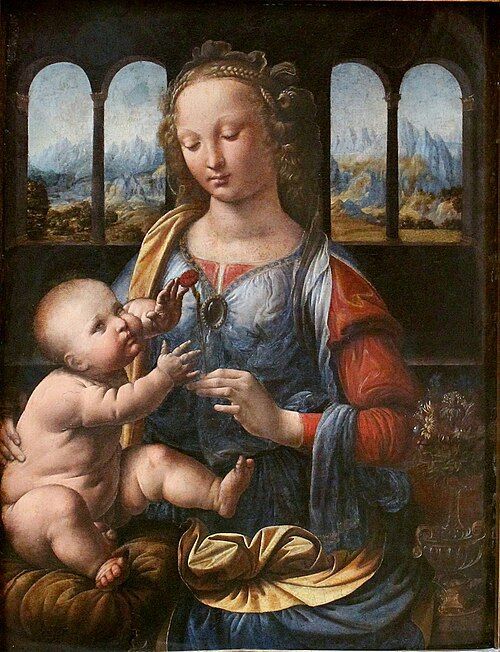
The overarching metaphor for Renaissance painting was that of a window on the world emulating a vision of the moment of looking in time and space. The canvas as a window was so powerful that Renaissance painters began placing windows in the backgrounds of paintings set in interiors (see Leonardo’s Madonna of the Carnation,1478-1480). Linear perspective guides our vision down zones of depth where foreground, middle distance, and deep distance fluidity meld.
The openness of the so-called Renaissance window is the frame to inhabit and populate the world. Notwithstanding its theatricality, it represents boundaries, protection, and perspective (physical, mental, emotional, spiritual) as it does memory and identity. In social science, “framing” refers to how information is presented and interpreted, influencing perspective and opinion.
The open window or frame allows eye passage and transition. A boundary and connection with inside and outside worlds. As an observation point, it highlights the importance of self-awareness and understanding, the desire for freedom and new experiences, as well as a pathway to exploring the unknown. Writers from Emily Bronte to Stephen King used “window” symbols associated with possibilities and new inroads to follow, transitions from one state or space to another, marking beginnings and endings, and psychological access. Spiritual domains between earthly and ethereal, the canvas as window can be the sister of silence or the bellowing echo of the angel of judgement. A frame for viewing reality or heaven.
Openwork is opportunity. A passage through. The Latin opportunus/ opportunitas, has the root meaning of porta/portus, “entrance”. Opportunity originally meant pushing toward the opening or ready to go through one. An opening through which Fortuna, Goddess of Luck, Chance, and Fate passed. A way and a means to associate the Goddess in Rome’s earliest days with a building called porta fenestella, a portaor opening above ground level symbolizing a divine or universal entrance akin to the Egyptian sun-door, the hole in the roof of the Navajo hogan, the oculus of a Byzantine dome, the aperture of the shaman’s Siberian yurt, and the roof above the altar of Jupiter Terminus. All by which we break out of this world. Reminders of the One who could say “I am the Door”.
- What secret depths may serve our salvation.
We have been looking at openwork from within time rather than depending on the timeless. The conditions and causes of creation and destruction, from aspects of art history with identifiable characteristics.
The experience of realizing openness can be compared to waking up. A continuum of occurring appearances within the illusory structure of successive causes and conditions. To be open– unlocked, unrolled, unfolded, natural, detached, unconcealed, unreserved, unclenched and so on – toward the Work means as soon as we posit something or influenced by other phenomena, they will exist by the power of each other, or neither would be truly existent.
To do openwork, we must ask ourselves what brings us into the “open”? We must realize to work “openly” means to work beyond subject and object. To the hidden destination we perceive everything as constituting the flux of the universe. Keeping ourselves open, uncertain and malleable, subject to impermanence is the ultimate essence or nature of the work we do. The signs are there. They tell us what truly exists. Being totally open and ready, edgy and aware, we co-arise with the Work that alwaysis subject to change.
Openwork allows us to see any visible clearing as the natural light of understanding. A depth of field where light and shadow create mimetic value of representation. Free from all impediments, literally or figuratively “seen through”. Conrad’s “clear vision of reality”.
Tides and stars
Patient as the
Darkness of night
Unbuttoned
Pours into me.
In the clearing we search not for memory bridges, solar systems, eobionts, a ratio for simultaneity of creations and states of being. As long as one thinks in a physicalist way, the fundamental character of the clearing (Ger.,Lichtung) as light (Ger., Licht) is not seen. Clearing is a free region where things are present in the composition of the painting, coming across or standing opposite one another. Coming further forward and seen with more attention.
It is “open”, an “openness” that affords any possible appearing and showing. Light and dark come into play. Everything that comes to be present and absent. A place of stillness out of which there is the possibility of the co-belonging of perceiving and presence. A “timing” as well as a “spacing”. The ensuing struggle between hiddenness and unhiddenness where wholeheartedness dominates the domain. Not two or dual but the essential unfolding of one.
Here then is the contemplation. Just as silence holds an opening for quiet and the potential for sound, being open and seeing what is open does not denote a blank or a lack, an absence of something. It is more akin to hollowness and swelling, as of a seed as it expands. There is the potential for fullness. Like the zero is a round circle with nothing inside. The promise of becoming, a process of emptying out.
An open zone for unbounded curiosity. Without it, there is no room for imagination, for creativity, for things to be other than they are. These echoes of emptiness challenge us to have a wider perspective, an unknowingness and improvisation along the selfsame continua, each distinguished by its own openness and levels of attention. A sense-sublime of something far more deeply interfused that precedes reasoning about what is to happen, including the possibility of nothing happening.
Predicated on what has become what there is.
Presences evinced at the surface
The shuddering of soul
In the form of a hand
Shadows of appearance
Inscribing themselves.
- To appear is to exist.
Dehiscence is a biological term referring to the spontaneous opening at maturity of a plant to release its contents. It also has a medical meaning as in a rupture of a surgical wound, or of an organ or structure to discharge its contents.
An open restlessness is always looking at the Work to see what to do next.
Making room for clearing of mind is a repeated emptying of assumptions and preconceptions, an act of contraction to avoid literalism, doctrine, or dogma. The arrival of revelatory appearance, its presence out of absence, negates artificiality for essence. A quiddity or “whatness”(what is) that is the breakthrough of infinite possibilities.
The receptiveness of which we speak is incorporeal consciousness. Where we stand it has the appearance of a diaphanous membrane separating inside from outside, perception from imagination, narrative from experience. Neither wholly one nor the other. A ready accessibility that invites us to travel freely within the ambiguous space of our Work. Creating an absence that demands our presence. The more space is allotted to openness, the more important it is to engage the space, feel its physicality as in a lucid dream. Open at the inception throughout the process to conclusion, it brings into expression correlated forces, change and divergence of viewpoints, where anything and everything is possible.
- Don’t drink by the water’s edge, throw yourself in.
Rather than absence, there is the ghost of presence in openness. Something omniscient that gives it a different reality. An anticipation or projection, perhaps. Without discovering this openness to the hitherto unseen, there is no point in painting. The important thing is to magnify something in the Work. See it in a roundabout way, and in the process make a new discovery. Every image, pattern, form and shape should move toward the completion of the whole.
For this to happen, there must be choiceless awareness. This implies an awareness of the Work as a totality and to be aware of the process in which we work. Rather than “I like this”, “I don’t like that”, we observe without the background of conditioning. There is an abeyance of opinion. We stand mentally naked. Looking forward to finding out, a condition of inquiry, which means that we don’t start with a conclusion. Alert to every movement of the zenith-bound brush, to our thought, observing our response. We watch without choice, without judgment. Aesthetic judgment comes later. In other words, we must look at the Work in process without a center, without frontiers.
This is what it means to be totally open and flexible. Totally free in order to break up prior rigid expectations, fixed perceptual patterns. Flexibility permits
the requirement of restructuring, organizing these fluid ingredients into meaningful, appropriate solutions. Let us not forget during these multiple sequences we disregard irrelevant visual information.
The tendency for greater creativity is expressed in divergent thinking. You must be open to changes in both creative behavior and fluency. Awake to the moment at precisely the right time…
to unfold.
- Painting today is no long a function of the eye; it is the function of the one thing we may not possess within ourselves: our LIFE.”
- Yves Klein
Opened as if by an eddy, on some wall, a night country where the path is lost.
From the thousand empty spins of the pejorative self and paradigm-shifting practices we walk on the edge of madness for the desire of lost images. As if suffering from a defect in vision, we kill the injured. Yet to the flesh of our unity and to the center of our dark cloud we remain adaptive, affirmative, intuitive. The belief in immaculate beginnings winged by unconscious improvisations that are expansive as well as compressed. The longing for unmediated experience. However, we must examine and appreciate the complexity of our response. New forms of expressions that exploit the rhetoric of spontaneity and share the deep concern for openness with the dilemmas of freedom and constraint. Those hidden tides which govern everything but every now and then point in a direction before relapsing into their own inscrutability. Thoughts like birds Jung said that come and nest in the trees of consciousness for a while then fly away.
The Work is not just an open window; it is the door of an open house: After the door, I am – and open, in what I have opened. (Andre du Bouchet)
To get there we have to cut a path through the lianas of habit. Surfaces will then bloom, an effulgence that pierces appearance. Stirred by awareness, the paradox of painting becomes the seed of infinite expansion. Objects of external reality waiting for our attention as they unveil their endless ambiguity. What holds us is what we cannot grasp.
- Whenever the jolt of existence loosens the gag.
…you recognize yourself in the identity you have lost, yourself like a look that blindly rests where the blind hand rests.
(Andre du Bouchet, Painting)
Comments