A Meditation on Color
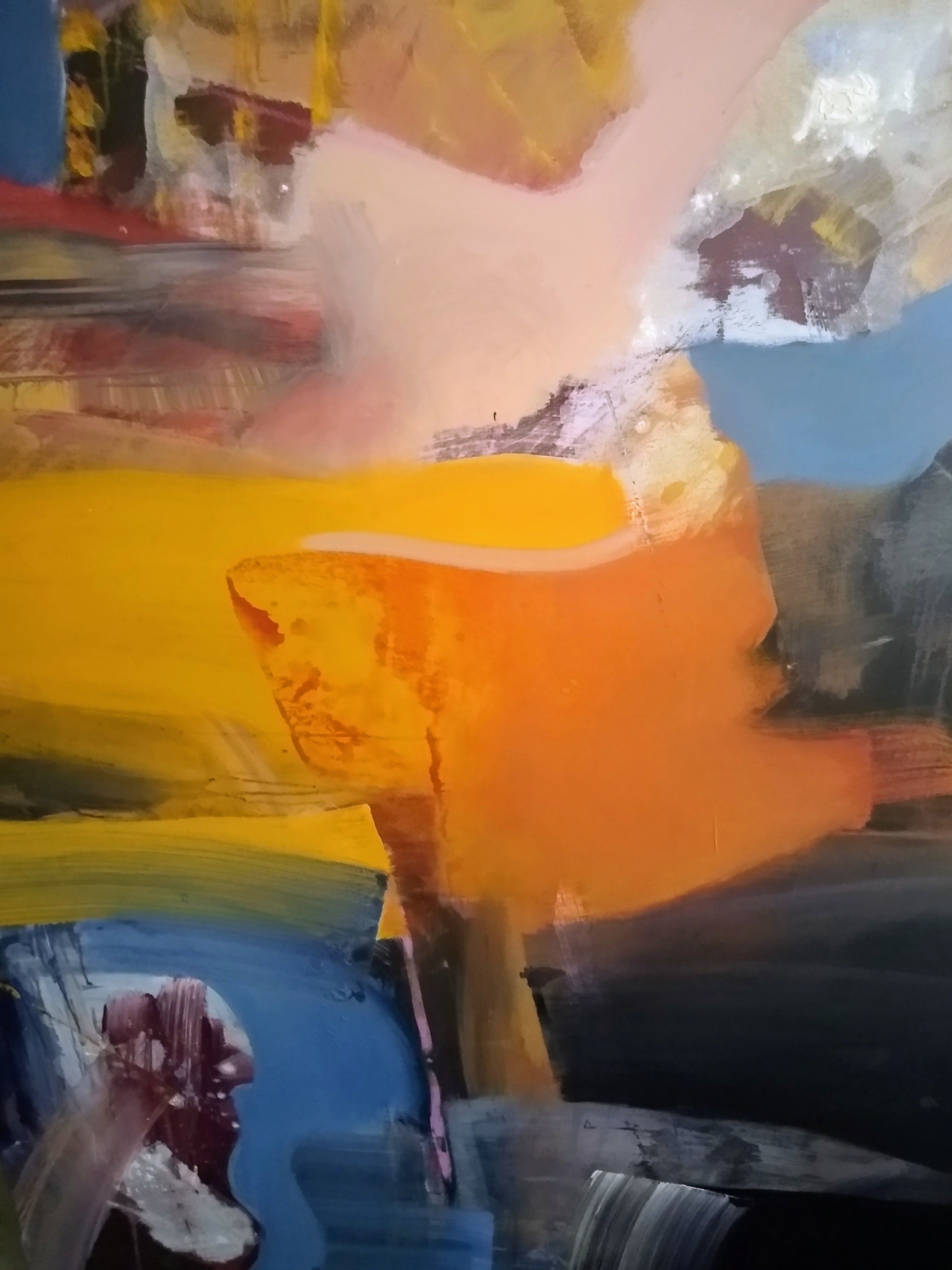
for Steve Joseph
Everything begins and ends with the eye, within the eye. Before the object there is an image. Before the image there is a color. Before color there is a desire standing in the mist like a white horse with a red mouth.
As we are interiorized in our minds, in our cars and in our houses, and no matter how large, in our world, color is the secret articulation that annihilates our borders and boundaries. Color forces us onto the invisible crag of our contradictions: rosy and warm like an exhaled breath, depressed in weeping blue, whitely whispered as a ciphered hymn.
Color is the lightning flash of wakefulness: the color of the mark a bite leaves, the ringed eyespots of a peacock feather. Color is astringent: the tony black that is almost blue. Color is a crimson continent, a song in damp violet, the crucifixion on the mountain: time’s nerve in vinegar. We pause and puzzle. What seems marginal and decorative is suddenly substantive. Instead of closure there is disclosure.
We exorcise real-world logic for radical amazement. We seek the inner life (Immenleben) of color, the first throbs of the object. We stay any ascesis that separates us from our experience for that would kill the desire for color which binds us to what we look at. We understand that the beatitude of color is not the deliverance fromit but the immersion *in it.*But fair warning: color doesn’t reign absolute. To see color as unchanging is to see it as an all-pervading fatuity, static and enameled.
Color: that aspect of things caused by differing qualities of light reflected or emitted, the appearance of sources involving hue and saturation, brightness, luminance, and purity.
Lucretius’ Meliboean purple or the yellow gamboge made from the thick rind of mangosteen. Colors like newly discovered flowers tremble before us as besieged by a swarm of bees. Even the substance defined in the dictionary as a dye, pigment or paint, anchors us to what-is. With each blink of the eye comes a fresh awakening, a first light laden with possibilities.
Desire and pain, universals in our world, are particular to Rimbaud’s “postscript” to his mysterious *Voyelles.*He speaks of the broken russet at vermillion nipples and a man bled black. Literary colors, rich in syllables, yet rising above its beating sonority. In a poem by Yannis Ritsos, a naked woman in Ekatachrome intensity comes from behind a red curtain holding two oranges in her hands. How extreme yet unadorned are the colors of intimacy and passion! Musing over color the poet Gilbert Sorrentino asks is the word grey spelled with an e “greyer” than the same word spelled with an a: gray?
Yet color is the one phase of art that is also a science. In the 19th century, physicists made discoveries about the component prismatic parts of white light, and pointed out that the sensation of color has more to do with a retinal reaction in the eye than with the objects themselves. The color wheel demonstrated that two separate hues in rest are fused by the eye into a third hue when the wheel is spinning. When all the colors of the spectrum are rotated the eyes see them as white. This interest in “optical realism” was pursued both by Monet and Seurat in their (although different) “broken-color” techniques. Gauguin created quiet two-dimensional color designs whereas Cezanne retained both light and color for the geometrical organization of his surfaces. What can one say about Van Gogh’s yellow? Other than it is pure alchemist’s gold. A painter like Mark Rothko appears as a chromatic abstractionist when his vaporous rectangles of color float in a generalized atmospheric space. Colorism also plays an important role for Philip Pearlstein in his rendering of cascading volumes of flesh by means of rich and complex blends of hues applied in a wide range of light and dark values. We suddenly are aware of an ontology of color.
As religious and cultural symbols colors possessed deep significance. Among the Chinese red symbolized good luck. For the Hindus red was the traditional color most often associated with women who wore a red sari at marriage and were cremated at death in a red cloth. However, in the early Greek world red was an attribute of Dionysus; and in the Bible red was the color of sin (Is.1:18) andresurrection (Is.63:2). But red as the color of blood was a synonym for the aqua permanens,the liquid version of the self. At the same time it gave meaning to human beauty and lust, it possessed the color of sanctity as in the case of Mary, St. Elizabeth, and St. Teresa. Green was linked with Islam, a “Muslim” color. But in Celtic myths the Green Man was the god of fertility. Later in the millennium, early Christians banned green because it had been used in pagan rites. Yet by the 15th century the color green was the best choice for a bridal gown because of its early symbolism of generative capacity (see Van Eyck’s Giovanni Arnolfini and His Bride, 1434). The Paracelsist Bernardus Penotus tells us green is the color of the Holy Ghost and life after death. Black was worn by many Islamic women, perhaps under the influence of Mediterranean Christians who clothed women in black for centuries. In Christian symbolism black signified death and the underworld, the Prince of Darkness, mourning and negation. Yet black and white together were meant to stand for humility and purity of life as in the distinctive clothing worn by members of the religious order of Dominicans.
From the ecclesiastical view of purple that expressed the mystery of the Christian passion to the mystically colored sefirot of the Jewish kabbalah, the Persian poet’s assertion that the earth from which Adam was made had seven colors, the multicolored goddess Iris who personified the rainbow sent to rouse the sleeping Morpheus, and the blue-eyed blue jay and black-faced cardinal color has invoked mystery, sacrament, and revelation. As fragments of our conceit as well as a simple way to participate in life, color heralded the imminent synthesis of the qualities and elements of our abundant world. Long have we shadowed its meanings and contradictions. We gladly and whole-heartedly embraced its effects. Yet with a thief’s walk we have allowed it to sneak up on us simply to annul the temporal world. Or, to spin a whirlwind labor of words and images into a litany of glory.
Comments