A Companion of Alternate Terms for Thinking About Your Work
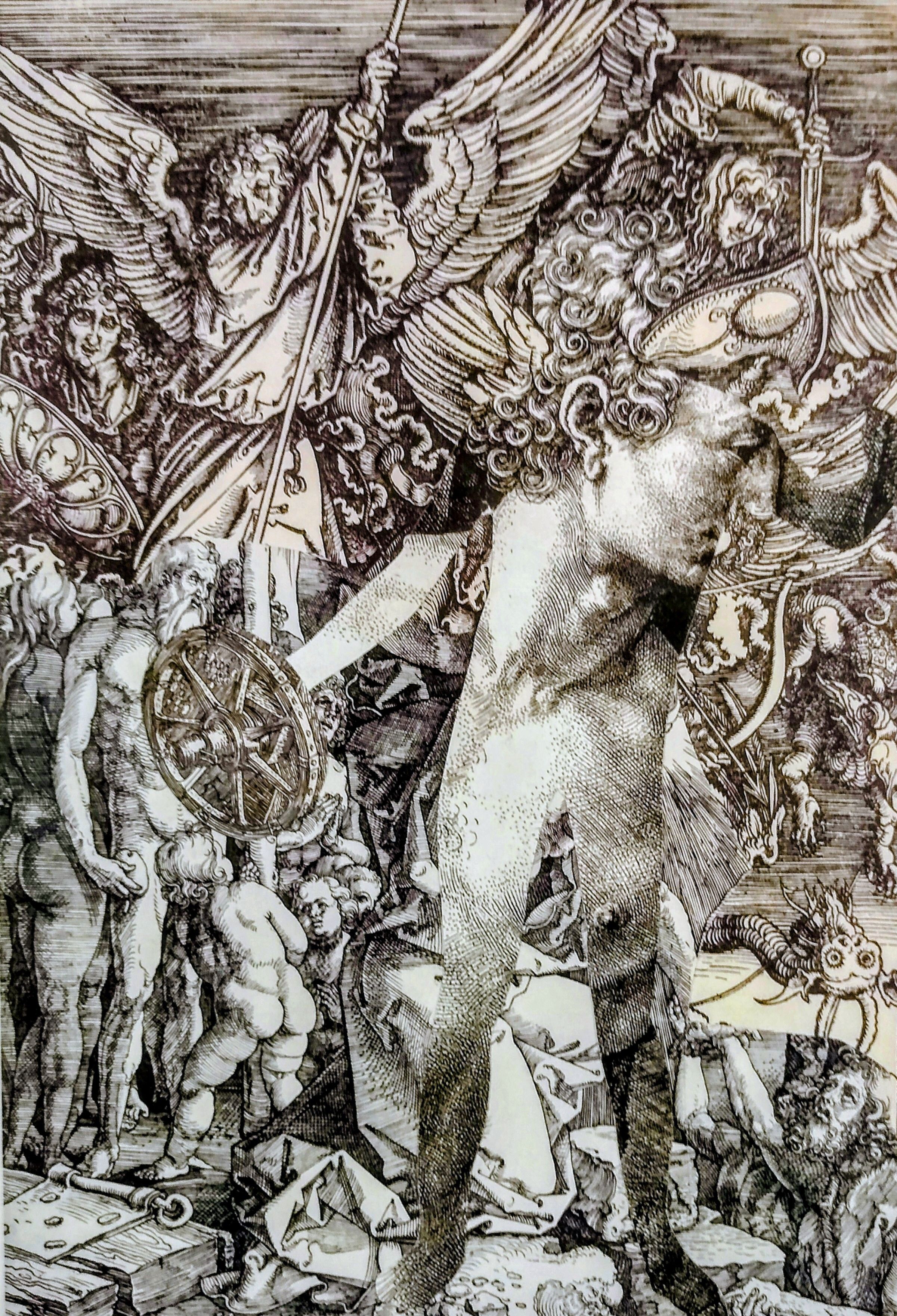
Before you there is a set of terms. Use them freely, mutatis mutandis, to have a more expansive way to look at and criticize your work. They incarnate depth experience, re-imagine larger possibilities of understanding. They indicate their hidden sense, meaning, and how to approach deeper dimensions. For example, the terms surface the underlying structure of your thought and inform your experience as painters and as human beings. They exert a profound psychological and spiritual influence on how you see your work and perceive reality. Terms not set in stone but rather looked upon as “companions” along the Painter’s Path to be ensouled. In other words, a continual and essential guiding force with multiple layers of meaning evoked through active engagement. It is my belief they will open new horizons and understanding in nonlinear ways from the “other side of consciousness”, individual pathways toward self-understanding. Set against the background of a process of unfolding, these resonances between realms of emotion and imagination move you towards a unique revelation of concealed identities. Implications in forming the painting’s image. Stages that reflect the psychological and metaphysical thrust toward a thoroughly creative dimension. A five-petalled blossoming of sowing (the seed), conception, birthing, nursing, resulting in a new consciousness that brings to light vital and thought-provoking aspects of work; the manner in which you approach it, and how you refigure prevalent possibilities towards a broader framework of understanding relatedness. Everything substantial for the perfection of humanity.
-JG
How to use the terms.
Read over the list to familiarize yourself with the terms. How they look and are pronounced, how they sound. Randomly select a term or begin with the first term on the list. Repeat it three times, aloud. Look at your work with the term in mind. See as many ways as possible the term can or cannot apply or augment the work. Each term is different and may have a new angle on your work. For example, “Active Imagination”. What does this mean to you as an artist or to your work? If active imagination is a method of assimilating unconscious contents into your work (dreams, fantasies, fears, etc.) normally not seen or overlooked, how do you interpret what is happening in the painting? You do this by concentrating on the image, by catching hold of it. Turn the term over in your mind, taste it. Let your mind roam or remain “empty” (as in meditation). What effect has the term on the image? Contemplating the image animates it. Make an honest evaluation specifically of your thoughts and feelings or anything that generally percolates into a thought or insight. Recognition marks the beginning of the opening.
Terms in bold type are “hints” buried into the teaching that will give context to a deeper meaning. “Translate” them to fit your studio practice and self-critiques. Integrate what you learn. Relax with the practice but work at it. Give it time.
Active Imagination. Akin to Buddhism’s alaya vijnana, “storehouse consciousness.” The unconscious level of experience where habits are maintained and where they are transformed. Instead of the repetition of habits and conditioning they can be integrated using innovative concepts and be profoundly influential in your studio work. Tapping into an unconscious image that has been brought to the surface during the non-doing process of active imagination. Follow any line of thought that spontaneously comes to mind and act upon it without thinking. What stays with you is a transformation of self-expression into a visual (visionary) recital. The received image is acted upon, witnessed, and noted.
Amplification. Method of associating the root image or composition with something else like a poem, myth, religious or philosophical concept to augment or expand the painting in one’s heart, psyche, or mind.
Appearance. The coming forward of the received image. Seeing the image in an open realm or different light. To know the process was due to self-abandonment and selflessness. There is nothing but the unveiling of things.
[See The Received Image, Imagophanic Revelation].
Apperception. Another way of seeing emerging forms or patterns. Focused on disclosing the inner shape and structure from the outer body or surface. Try to make sense of the work as a whole or their individual parts. The mental process will bring the form(s) into a unity as something you forgot you already knew. A new conscious content will be articulated in the work. Active or passive, you will grab onto something entirely new. Content will arrive directed from the outside through the senses or undirected from within the unconscious.
Archetype. Major images, ideas, symbols, patterns or motifs. Characteristic that appears again and again symbolizing the universal, and univocity (that is “having one voice”). One of a kind intelligible pattern or “over-arching” form. An image or composition that carries or contains the constitutive power of an icon or paradigm but includes individual experience. Expresses itself in metaphors. An image that “hangs in the air”, grows in worth, becomes profound as it portrays its own primal (originary) meaningful expression. It is not so much a question of instinctual images, inherited ideas or identities but of inherited possibilities common to all as can be seen from their universal occurrence. The shift in the value dimension of the image or total work is a seeing through to the changing inscape. The task is to find new interpretations, to connect life that still exists in the past with the life of the present. [See Primordial Image, Inscape].
Authenticity. Realization that you are not a fixed entity like a rock or table, defined by your skill or lack of it, but a freely creative person making creative choices.
Availability. Being available or receptive to creative situations. Open, waiting for the image (ebbed backed beneath our snowy lids yet unseen).
Blossoming. Looking at your work – individually and collectively – as a “natural field” and the process of painting as “seeding” or “coming-to-flower”. Concentrating on work until something comes alive or has the promise of life (development). “Old” images can be reanimated if reworked. Having been laid to sleep or fallow (left unsown in order to restore its fertility) a sudden “scent” (intuition) will awaken your attention to new ground. This appearance and inner intelligibility enters the “pores”. A supersensible reality reflects something more or beyond, shining in the work, emanating and burning outward.
image (lower case “i”). A representation of the external form or a general impression, likeness, or assemblance exclusively. An image that has an outer form or “casing”, often associated with its surface and loss of the universal. The flattening out of its inner depth and self-substantiation (self-sufficiency) resulting from its standing-in-itself for nothing other than commodification.
Image-as-Koan. Zen narratives posed by a roshi to students during training, a meditation “technique” that goes back to the 8th C. Indifferent to convention koan (Ch. gongan, “public case”) emphasizes the absurdity of any on-going, shallow analysis and interpretation prior to great clarity. In this respect logic or reason rarely produces significant in-sight into the image. As we do not understand or even know how to understand The Received Image, we approach work by finding a way into it, exploring the thought and language it generates. From this non-linear “reconnoitering” comes a deep mind-cleansing. This unorthodox practice/inquiry is “striving after the root, not chasing after the branches”.
Imaginal. Subtle in-between state or realm that exists in a field bounded by matter and mind. Not a literal world with geographic co-ordinates or borders but of unconscious energies and autonomous inner realities. Relating to Imago and Visual Recital. Configuring this field into one’s studio practice and the world the artist looks inward as the work looks outward in unity.
Imaginatio Vera. Active imagination empties out fantasies or other thoughts for a vision beyond noetic or plenary cognitive value. A deep-boned spontaneous intuition from self-reflexive painterly actions.
Imago (upper case “I”). Event of the soul. Redemptive knowledge that is transforming. Representation of the unconscious or the interior world with multiple luminosities. As a center everywhere, it is a dynamic, spontaneous process showing itself “as-it-is”, “self-so”. A haecceity or “thisness” identical with resonating appearance suggesting that meaning is already present. It can begin to reveal itself in the process of painting. A creative tension [See Instress] between concealment and disclosure. It does not copy but creates its own living space. It makes us listen to the echo of ourselves through an internal dialog from full evocation to contemplation. Portrays its own meaning in shape or appearance. Polymorphous and fecund with implications, an imaginal body allowing the artist to discover a sense beyond the personal. An indicator of knowing. Paredros, guide, herald, link, alter-ego, mediator, or Angel of the Face, it corresponds to a state and mode of being. It does not prove or explain the self, soul, or psyche but through dramatic change in form and appearance becomes a “magical influence” not conditioned by the ego. It is the locus of spiritual energy, of the true imagination, both the intermediary and mediating project of the imaginal. As it offers itself through visual form as an animated possibility, a sensuous presentation bespeaking of inner life and a world ensouled. The final or mature stage of the work. [See Imaginatio Vera/Mundus Imaginalis].
Imagophonic Revelation. Radical shift in seeing. Numinous pure experience of appearance. Sudden revelation of Imago or “The Image” born from “emptiness”. Suprapersonal disclosure. Total self-knowing (i.e. the truth in painting).The term I coined to express how images appear before the final stages of painting: Imago (“image”) + phany (“appearance”). [See The Received Image/Numinous].
**Memory.**Thought is a response to the past and the projection into the future. Responses are encoded, stored, and retrieved. They are limited and change when recalled. The psychological relationship between perception, contact, sensation, desire and thought arise through identification with the fictional self. Like time and space these are creations of the conditioned mind, a distortion of lived experience. When associated with success or failure, it is a dead rose of reminiscence that interferes in the process with negative self-criticism.
Mundus Imaginalis. The imaginal world of abstract forms, the psycho-cosmological ground for physical reality. The bandwidth between the senses and the intellect. A world of archetypes, forms and patterns that reside in the collective unconscious. A world of visionary perceptions and inner revelations that cannot be understood in a discursive sense.
Numinous. Usually defined as a spiritual or religious emotion, sometimes mysterious and awe-inspiring. From (Lat.) numen,[Roman] deity/spirit presiding over a thing or space. Deep emotional resonance, dynamic agency, or effect independent of the will of the painter that causes a particular alteration of seeing.
Presence. A coming-into or coming-about and reception of the deep focus between the painting and the painter. A mirror-play that opens the eyes to oneself and the world through Imago, The Image. Pure actuality, fullness, unhidden and self-moving, forward appearing as Be-ing. [See Imagophanic Revelation/The Received Image].
Primordial Image, Primordial Recognition, Primal Eye. Within the structure of the brain, the inherited psychic or instinctive element characterizes the revelation of Image. Recognizing universal patterns or motifs from the collective unconscious. The whole work flushed with star points suddenly, rightly received. [See Imago/The Image/Archetype].
Psyche. A complex interplay of factors. Projector and projected. Mediator of meaning. Breath of life (pneuma) of the painting, soul, anima, spirit. Principle movement (kinesis) subject to rebirth (i.e. from chaos to creation, mud to clarity) as painting is reworked. Fertilized the psyche turns toward its source, the Intelligible, as it turns toward the world which it visualizes and vitalizes. Governs as it illuminates matter and all psychological processes conscious and unconscious. Jung’s “boiling cauldron of contradictory impulses, inhibitions, and affects”). [See Soul].
The Revealed Image/The Received Image. Sudden appearance of Imago, The Image. Manifestation received through no will of one’s own other than the result of Process. [See Imagophanic Revelation’].
Releasement. Repeated emptying of assumptions and preconceptions. Making room, a clearing, or act of contraction for embryonic Imago. The Image becomes incarnate in the painter and the painter in Imago. If the mind is not void, releasement is prone to literalism, doctrine, or dogma. Arrival or revelatory appearance in an instant, an eternal now. “Isness”, “suchness”, and “being” (presence) of The Image negates artificiality for essence (quiddity or “whatness”, what is). The birth of Imago is a blossoming breakthrough rather than the appearance of conventional form. The Image is seized when there is releasement of “belonging” (grasping). Results in Infinite possibilities. An intuitive way of looking at and seeing the work in contra-distinction to analytical or logical understanding.
Reverie. In which Imago comes clean, quietly professes itself, and is inseparable from the painter. To know how to paint is to know how to see immaterially, reverentially. The dream-like state of a soul being born that bears witness to its true residence. The Received and Revealed Image that, in repose, makes us conscious of the tissue of our existence. A return to soft memories as the ah-ness of things without the self’s drama, history, or ornamentation that releases in our eyes the glowing colors like maple leaves of a winter afternoon.
Soul. The imaginative possibility in our nature recognizing all realities as symbolic and metaphorical. Fertile, natural state, empty and receptive to revelation. The automatic fruit of detachment to live without why: erotic, unconscious, inner-personal. Phenomenological re-presentation of Imago with depth, complexity, and purpose. Imago opens aesthetic insight of how inner personality makes itself known and how it spills its painterly features. [See Psyche].
**Spontaneity. Of-itself. Self-so.**Self-ablaze. Naturally occurring. Appearing of itself. Moving in and out of the flow of the process of painting. Absence and Presence giving birth to one another. Action in which everything is alive without apparent cause.
Visionary/Visual Recital. A work that projects (recites) the most personal and deepest, often unknown, forms and patterns of ourselves and the world. An insight into who and what we are through apophenic seeing: the connection of unrelated things and patterns (like seeing faces or shapes in the clouds).
Waiting. To delay action in order to be attentive. Scent and incubate. When the essence of things is aroused through scenting, for example, it is taken close to the heart. It is a recalibrating experience. An opportunity to re-imagine beyond purpose or place. Waiting at the Door of Presence. Invested with infinity, however, we sometimes lack the suppleness to see it. It is necessary to seek it at the articulation of transcendence. [See Presence/Releasement].
Comments